The Susan Ryeland Mysteries
The Susan Ryeland Mysteries
5/29/2026 | 56m 48sVideo has Closed Captions
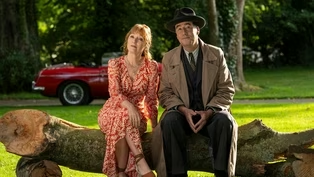
Explore the making of Magpie Murders and Moonflower Murders, two clever mysteries-within-mysteries.
Explore the making of Magpie Murders and Moonflower Murders, two clever mysteries-within-mysteries. Lesley Manville stars as Susan Ryeland, a book editor who reluctantly takes on the role of amateur sleuth when she finds herself involved in murder. Interviews with the cast and creators offer behind-the-scenes insights into the making of the series.
Problems playing video? | Closed Captioning Feedback
Problems playing video? | Closed Captioning Feedback
The Susan Ryeland Mysteries
The Susan Ryeland Mysteries
5/29/2026 | 56m 48sVideo has Closed Captions
Explore the making of Magpie Murders and Moonflower Murders, two clever mysteries-within-mysteries. Lesley Manville stars as Susan Ryeland, a book editor who reluctantly takes on the role of amateur sleuth when she finds herself involved in murder. Interviews with the cast and creators offer behind-the-scenes insights into the making of the series.
Problems playing video? | Closed Captioning Feedback
Where to Watch The Susan Ryeland Mysteries
The Susan Ryeland Mysteries is available to stream on pbs.org and the PBS app.
Providing Support for PBS.org
Learn Moreabout PBS online sponsorship- [Narrator] The Susan Ryeland mysteries of "Magpie Murders," "Moonflower Murders," and the new "Marble Hall Murders," are beguiling mysteries within a mystery, adapted from Anthony Horowitz's best-selling books.
- [Locke] This is the real world and I don't need some fancy ...editor from London, poncing around pretending to be some sort of private detective!
- [Narrator] Susan Ryeland is the editor for the Atticus Pünd mystery novels.
Each volume is two mysteries, one in Susan's world and a book-within-book detective story set in the 1950s.
- Mr.
Spencer, although it is, um, painful to ask you this, even so, it is necessary... were you aware that your wife was having an affair?
- [Narrator] Wildly entertaining, outrageously clever and relentlessly suspenseful, the Susan Ryeland mysteries are a deviously dark take on vintage English crime fiction in which you become the detective.
- [Lesley] I think what makes a great mystery is what makes great drama.
- [Narrator] Join us for a special inside look at "Magpie Murders" and "Moonflower Murders," (car zooming) plus a sneak preview of the new "Marble Hall Murders."
- But I'm not a detective.
(waves lapping at shore) I can go to the hotel, but I can't investigate-- I wouldn't know where to begin.
- Do you believe that Cecily Treherne is dead?
(waves lapping) - She's been missing for five days.
- Then that is where you must start.
(seagulls calling) (Susan sighing) - [Narrator] We'll investigate every aspect of these fiendishly brilliant whodunits from MASTERPIECE "Mystery!"
including learning what it's like for certain members of the cast to play two different characters in two different time periods, in... (typewriter clacking) "The Susan Ryeland Mysteries."
(suspenseful music fading) (clock ticking) (ominous orchestral music) - [Narrator] As we begin our examination of the Susan Ryeland mysteries, let's start at the beginning with an introduction to "Magpie Murders."
(ominous music continuing) (clapboard clacking) - [Director] Action!
- Have you read "Magpie Murders?"
- It's a crime thriller, uh, whodunit, uh, in two different time zones.
The present day and in the 1950s.
- [Daniel] The modern day storyline concerns the famous author Alan Conway, who is famous for writing the Atticus Pünd murder mysteries.
(ominous music continuing) (typewriter clacking) - [Alan] Chapter One: Sorrow.
"There were many who considered Atticus Pünd to be the world's greatest detective.
But as he walked down Harley Street on that awful..." No..."fateful."
Yeah... (pen scrawling) "...day in the summer of 1955" "Chapter One: Sorrow.
(computer keyboard clicking) There were many who considered Atticus Pünd to be the world's..." "A single magpie watched him from a tree as he returned.
What was it telling him?
(computer keyboard clicking) He was about to find out."
(single key clicking) - Who has recently died, apparently committed suicide, and who's left the final Atticus Pünd novel unfinished.
- It's missing the last chapter.
- Really?
The last chapter of a whodunit.
I can see why that might be a problem.
- That's why I'm here.
- And so it's about what happens when the final chapter of his latest book goes missing and we crisscross between the dramatization of the book and the chief editor, played by Lesley Manville, trying to... kind of become a detective herself.
- I know it's going to sound crazy, but I'm here to look for the last chapter of his new book, "Magpie Murders."
- Is it missing?
- [Susan] Well, we don't even know if he wrote it, but he certainly never sent it.
Now he's dead and we really need it.
I mean, we could go out of business if we don't find it.
- [Anthony] Susan Ryeland exists in the modern world, the present day, but the book she's editing, and which we dramatize, is set in 1955.
So half the time you're in the present, and half the time you are back then.
(car engine rumbling) (intriguing string music) - [Tim] The two time streams they kind of oscillate together like that.
And so you learn about one from the other.
- I'm going to find that missing chapter, you know... I'm going to work out who killed him.
- [Charles] Are you really sure he was killed, Susan?
After all, you must admit it does seem a tad unlikely... hm?
A murder writer, murdered.
- [Alexandros] What makes "Magpie Murders" so interesting is the whodunit in the whodunit.
You know, it's the play within the play.
- [Anthony] This series mixes them together, in a, in a very unusual and, and I think quite delightful way.
- You're not writing any more Atticus Pünd then?
- [Alan] Atticus Pünd?
If that's the level of your expectations, maybe you're wasting your time and mine on this course.
- I only asked.
- Remind me, what's your name?
- It's... Brent.
- Brent.
I'll remember you.
(discordant string music) (pen unsheathing) (discordant music continuing) - [Alan] "Brent, the gardener at Pye Hall, (water splashing) lived in a two-up two-down he had inherited from his mother.
She had long gone and now he lived alone.
(spitting) Early the next morning, he pushed aside his foul-smelling laundry and the Boy Scout magazines he liked to read, (floorboard opening) and lifted a floorboard to recover the property he had stolen.
(tense string music) This was, of course, part of the treasure trove of Sir Magnus Pye, which had been found by the lake, and which had been stolen-- it was thought-- by burglars.
(tense music continuing) Brent, of course, had no idea of its true value.
(pen scrawling) But then, he was ignorant about almost everything."
Hm!
- [Anthony] Everybody in the book... is based on somebody in the author's life.
- Alan put you in his books.
- [James Taylor] Nice of you to notice.
Yes, I'm "James Fraser," the thick assistant.
He did that to everyone, and not in a nice way.
He liked to play with people.
Actually, that's how it was for him-- writing.
It was all a game.
- One of those people has murdered him.
- Was there anyone Alan didn't argue with?
- No.
And if someone really did push him off that tower, well, put it this way, there'd have been plenty of volunteers.
(mysterious orchestral music) - [Anthony] I hope audiences are going to get a great deal of pleasure out of this series because we are dealing with these two worlds.
- So somebody killed him.
(intense percussive music) And don't you see?
(intense music continuing) It's his last novel, and everyone he knew was in it.
And that's why the last chapter was taken, because it reveals the secret.
(music intensifying) The answer's in the book.
(music crescendoing and concluding) - [Narrator] Through production design, costumes and locations, "Magpie Murders" takes us through two worlds simultaneously.
(whooshing sound) The world of Atticus Pünd in 1955 and the world of Susan Ryeland in 2021.
(eerie orchestral music) - [Alan] "Chapter One: Sorrow.
There were many who considered Atticus Pünd to be the world's greatest detective.
(mystical orchestral music) But as he walked down Harley Street on that fateful day in the summer of 1955, (echoing footsteps) he knew that he was facing the greatest mystery of all-- his own mortality."
(mystical music fading) - [Lesley] Well, "Magpie Murders" has two very distinct sections to it.
- Both of those storylines run parallel to one another.
So the structure and the form is mixed in.
They're like, kind of threads that constantly interweave with one another.
- So you can literally be in a scene where you'll see Susan driving up in her red MG to Abbey Grange, and then the camera might pan off of me and pan, come into Abbey Grange and there's the characters from the '50s.
- It will be wonderful for cutting between the two different storylines and seeing the echoes between the two stories.
(mysterious string music) (church bells distantly ringing) (crow cawing) (music turning ominous) (church bells ringing forebodingly) (ominous music continuing) - [Narrator] Many of the show's locations exist in both timelines.
For example, Abbey Grange, home of author Alan Conway, doubles as Pye Hall in 1955.
(gentle piano music) - [Louise] So, Glenmaroon House, as we know, was built in 1905 by the Guinness family and the house has played for both Abbey Grange and for Pye Hall.
You know, we've done subtle changes.
At the front of the house we've added... there's the entire driveway, gravel, we've painted lampposts, we've added in greenery, we've added in sculptures... The interior of the house, there are certain rooms that we have used, the entrance hall, the staircase, the living room, the study, and Frances Pye's bedroom.
Some of those rooms have been a certain-- one way for the contemporary world and then another way for 1955.
- [Susan] Maybe that's why he called his house Abbey Grange.
Conan Doyle didn't want to write detective stories either.
He killed Sherlock Holmes.
- [Louise] Study is pretty much in a similar setup to how it was for Alan Conway.
We kind of... have similar d- kind of designs in terms of placement of lamps but we've tried to kind of stick to some of the same layout for the 1955 as we did for the contemporary world just to kind of balance out, and make the audience feel like... we're in the same place, but we're not.
The desk, in, kind of in previous, um, setup for Alan Conway was in a slightly different position but we kind of... because the fireplace is so much part of the plot for '55, we kind of kept it a bit more open this time.
(suspenseful string music) - You see this, Detective Inspector?
(suspenseful music continuing) - Blank.
- No, there's no writing, but this stain may be of interest.
- [Chubb] Coffee?
- [Pünd] Or perhaps blood.
(suspenseful music continuing) - [Louise] For the contemporary world, this wall actually h- was pushed back and we had a set of, kind of Alan's books here so we could pull this wall forward, and... so we could insert kind of the safe into it so the painting kind of opens out.
It's made to kind of look like an old canvas at the back and then we designed it to look like an old kind of Victorian safe.
This is actually an egg timer, (laughing) which we put, uh- kind of engraved and had all this kind of stuff, uh, 3D printed and then you open up this and then this is where all the kind of documents and all of Magnus'... mortgage deeds and bonds... So, yeah, w- this is all the kind of bits and bobs that we would kind of recreate (gentle orchestral music) for the kind of 1950s so the- our graphics team were very busy making up all of this.
(sedate orchestral music) (papers rustling) - "You won't get away with it.
The village was here before you and it'll be here after you've gone.
Think again if you want to live here.
Think again if you want to live."
Unsigned.
- And hand-delivered.
- [Louise] So a lot of what has changed in here is say the artwork, um, furniture, all the furniture is completely different from Alan Conway's world.
His- he had moved to a more modern desk-- computer... So, basically it's a complete redress from 1955 to the contemporary world with all of... everything-- carpets, furniture, lighting, the whole lot.
It's kind of like a complete switch around.
So, it's kind of... we've kind of done a bit of like for like, but completely different at the same time.
- [Narrator] Abbey Grange isn't the only contemporary location that was also used for its 1955 counterpart.
- We're using the same village but we're going to-- it's going to just look, with the color adjustments, slightly different.
- [Pippa Haywood] So, we're in the village of Kersey today which is where most of the 1955 story occurs and it's the most beautiful quintessential English country village.
You feel that time has stood still here.
- [Peter Cattaneo] It's been great fun playing with the echoes and... even the things like Clarissa Pye's house and Claire Jenkins' house, where we've got the same shots and you've got like an old kettle and a new kettle, and you've got an old toaster and a new toaster, and I would kind of hope that people love the show they can actually look back and kind of spot all these little echoes.
- [Pippa Haywood] It's such a collaborative thing you know, you, you only see the end result on the screen, but the conversations and the working process to arrive at how you create the whole of the character, their environment, as well as how they look and, and how they are.
(whimsical orchestral music) - [James Fraser] Here you are.
- Mmm... Thank you, James.
Thank you.
(setting glass on table) (liquid spilling) - Oh!
Cheers.
- [Pünd] "Prost."
- So... how long do you think we'll be staying here for?
- Definitely a challenge because of the two periods and two countries-- the next bit of enjoyment is to- seeing how it all... works, kind of cutting between the two worlds and how they work together.
- You wish to know the answer?
- [Susan] Are you kidding?
That's all I want to know.
- [Atticus] Then come with me.
- [Susan] Now?
- You are too busy?
(laughing) - [Narrator] One element of "Magpie Murders" that makes it so unique is that many of the cast members are playing two characters.
(energetic string music) - [Anthony] Alan Conway, the author who lives in Abbey Grange in the modern world, has used everybody around him as inspiration for characters who are often less pleasant, so, for example his sister, Claire, who has no money, and who has worked as his secretary for a time and, and is a rather sad character, he has turned into Clarissa Pye, who is the sister of one of the main characters who didn't inherit the estate, who has no money, who lives on her own in sort of rancorous jealousy of her older brother.
I think that that example-- you can see what he's doing.
He's taking a real person and spinning a rather unpleasant story out of them.
- [Alan] "The sister.
Unmarried, unloved and always desperate for cash."
(door opening) (uneasy orchestral music) (door closing) (uneasy music continuing) "Clarissa Pye looked ridiculous, and she was the only one in the village who didn't know it."
(uneasy music continuing) - [Pippa Haywood] I play Claire Jenkins and Clarissa Pye, and they're both very sad, lonely characters, but whereas Clarissa is sort of no-nonsense and a, a school teacher and campaigning to save Dingle Dell and very forthright... - [Clarissa] To build houses on it would be an act of vandalism and I told Magnus that in no uncertain terms.
- [Pippa Haywood] Claire is much more retiring and less sure of herself and seems utterly without friends.
There's lovely nuances to play as an actor of having... similar situations for both characters, but with the different experiences and life experiences ending up with different characterizations.
- Yes, I'm on my own, yes, I have no money, but that didn't give him the right to ridicule me, to... turn me into some sort of grotesque loser.
Claire, Clarissa, the pathetic sister.
Anyone reading it would have known that was me.
He had no right to do that, no right at all.
- [Daniel] Without a shadow of a doubt, I think the main reason why I wanted to do "Magpie Murders" was exactly that concept of playing two characters.
(chuckling) It sounds like such an egocentric thing for an actor to come out with.
To play around with that-- to bring those two characters to life, how similar the two characters are, how different they are, that just lends itself to great comedy-- certainly with the characters that I'm playing.
You know, because Detective Inspector Locke, who's the modern day cop, is uh, he's like a bear with a sore head, he's very alpha male.
- [Locke] How well did you know him?
- We didn't get on.
(papers shuffling) - Why doesn't that surprise me?
(papers shuffling) Thank you for contacting me.
You've been, uh, very helpful.
(footsteps) - [Anthony] Alan Conway has turned him into Chubb-- obviously there's a, a play on words there-- and Chubb is y- your typical "Lestrade," or "Japp," you know, the sort of bumbling village cop who never gets anything right.
It's the same actor, two very different roles... uh, and yet very much connected.
(intriguing orchestral music) (footsteps) - Herr Pünd!
- [Atticus] My dear Detective Inspector Chubb, it's a great pleasure to see you again.
- [Chubb] (chuckling) Mr.
Fraser.
- Hello.
- [Chubb] Oh, it still baffles me how you did it last time.
Hm?
A dead body in a locked room, the key in the butter dish it made no sense to me at all.
- I was aware of that.
- I can't imagine what brings you to this neck of the woods a second time.
- [Lesley] We've got a really top-of-the-range cast, and I think the, uh, carrot for a lot of them-- apart from the obvious things, like the script and the great writing is that they get to play two people um... and 'cause you never really see that on television.
- I've never played two characters in the same thing with the f- unique format of the show it lends itself beautifully to the writer using the characters from his real life and then projecting them into his book and then getting the same actors to play those characters, it, it works really well for him.
- I was wondering, have you read it yet?
- I'm sorry?
- The book.
"Magpie Murders."
Alan told me he was going to put me in it.
As a character.
- Yes, he did, he made you the doctor.
- Ah!
Am I the killer?
- I don't know-- I haven't finished it yet.
- The way that Alan Conway has certainly taken revenge against particular people by... by being quite cruel about them and putting them in his novels.
- He played games and they were always games designed to hurt people.
- [Tim] But I mean, actually what he's done, is he, he's touched, in some cases, the truth about those people so actually their characters are also amplified to some extent by being in two time frames.
- [Matthew] Yeah, a big attraction to the job was getting to play two parts, and two very different parts as well.
- [Director] Mark!
(clapboard clacking) - [Matthew] Transitioning between the two characters can be difficult but hair and makeup and costume does a lot of that work for me.
I mean, when I put the '50s suit on and immediately the collar's up and the tie's tight, it affects your posture and pulls your shoulders back and you sort of grow and then your hair's slicked back, and, and all, everyth- every single hair is in place so immediately that adds to your character as someone who's more together and constrained and sort of straightlaced.
- [James Fraser] I can't say anyone seemed too sorry to see him go.
Look at those two.
(birds chirping) (background murmuring) - [Atticus] His wife and his son-- they do seem unconcerned.
- Well... he packed him off to boarding school-- she's already told us what she thought of him.
- [Matthew] Whereas in James Taylor... all the clothes are quite free-flowing his hair's all over the place and just a bit of a mess, and again that instantly gives you a character because it's someone who's quite laid back and quite slobby in their way of being.
- [James Taylor] What'd you think of my big speech after the funeral?
I hope you were there for it.
- Yeah, I heard most of it.
- I wasn't too mean, was I?
- Well, you were a bit.
- They all hate me.
They think I'm a gold digger-- a gay gold digger.
Makes it worse.
- Aw, I think you're being a bit hard on them.
- Well, it doesn't matter.
I won't have to see any of them ever again.
I wasn't expecting to see you again.
Would you like a coffee?
- [Sanjeev] With different accents, with different clothes... I mean it's, it's great fun to be able to just explore versions of the same person.
- [Pippa Haywood] You know, you read the script and you find so many clues for your character there, and then you get to try the costumes on, and then you get to rehearse, and it's like this gradual unfolding of who you are, but with a double treat this time.
(intriguing orchestral music) - [Narrator] When we return, we'll spend more time going behind the scenes and investigating the world of Susan Ryeland as we look at the second season in the series, "Moonflower Murders."
And later in the show, we'll see a sneak preview of Season Three.
Stay with us as we continue... (typewriter clacking) "The Susan Ryeland Mysteries."
(intriguing music concluding) - [Narrator] Welcome back to "The Susan Ryeland Mysteries."
Today we're going behind the scenes and unpacking everything we love about the series "Magpie Murders" and "Moonflower Murders" on MASTERPIECE "Mystery!"
Coming up we'll look at why a hotel is the perfect setting for a murder mystery.
But first, let's get introduced to the second season in the series-- "Moonflower Murders."
(intriguing orchestral music) - [Director] Action!
(clapboard clacking) - "Moonflower Murders" is a murder mystery within a murder mystery.
- Hey, Cecily.
- Dad, we've made a terrible mistake.
- What are you talking about, darling?
- Stefan Leonida.
I was right all along.
He wasn't guilty, he wasn't the killer.
- [Lawrence] Cecily-- Cecily, slow down.
- [Cecily] You know that book I bought, Atticus Pünd, it's got the answer.
- What?
- The real killer is named in the book.
- Cecily, you're not making any sense.
- Just read it, Dad, it's all in there.
- But... If it wasn't Stefan, who was it?
(door opening) - [Mark] This is a, a sequel to "Magpie Murders," and also a prequel.
- [Pooky] "Magpie Murders" was the death of Alan Conway and it almost caused the death of Susan Ryeland.
- [Katie] You're awake.
(inhaling deeply) Thank God.
- Katie.
- Andreas called and told me what happened.
- [Lesley] So, she makes the decision to go off to Crete with her boyfriend, Andreas, and, open this small hotel.
- [Narrator] Things at the hotel aren't going well for Susan and Andreas.
- What did he say?
- He's coming.
- Yeah, when?
- Well, he didn't exactly say when.
- Andreas, we have no electricity, we have plenty of water, but it's all over the kitchen.
What are we going to do?
- We'll manage.
- We have 14 guests at the hotel, how are we going to cook lunch?
- [Anthony] Then two guests walk into her life with a story they tell her of their daughter, Cecily.
- [Lawrence] It's not easy to explain- - She's gone missing.
- In Crete?
- [Lawrence] In England.
- And we've traveled all this way out to speak to you, Susan, because... (wistful orchestral music) we think it may be because of one of your books.
(wistful music continuing) - [Lesley] Before their daughter disappeared, eight years prior on her wedding day, a murder took place in their hotel.
- [Natasha] Sir?
(ominous orchestral music) (sheets lifting) (Natasha gasping) (ominous music continuing) - [Daniel] Alan Conway, the famous author of the Atticus Pünd novels, decides to use this crime in his latest book, "Atticus Pünd Takes the Case."
- [Pooky] Which, it transpires has all the answers to the murder in 2015.
- [Susan] Alan Conway came to your hotel.
- [Lawrence] Yes, he did.
And it's clear that he used the real events that have taken place as some sort of inspiration.
- [Anthony] And she's drawn back to England and to further murders.
- I should leave this alone.
- But you won't.
(intriguing orchestral music) (waves lapping shore) - I can't.
- [Conleth] We see Susan, played by the wonderful Lesley Manville, has to go back, and go through the book and try and solve a murder and a mystery.
But, like "Magpie Murders," we have the two ongoing '50s and contemporary investigations.
- [Mark] So, everyone basically plays two people, which is very exciting.
- [Will] It's so much fun to play the two roles.
Very confusing, and very tricky, but, um, but it's been, it's been great to see how they inform each other as well.
- Have you actually confirmed that he did indeed attend the opera?
- I hadn't thought to do that, Mr.
Pünd.
- Well... Perhaps you should.
(somber orchestral music) (fingers snapping) (footsteps) (door opening) (somber music continuing) - [Locke] I'll, uh... I'll wait to hear from you, Mr.
MacNeil.
- It's irreverent and witty, and a little bit naughty, a bit cheeky.
- [Tim] With lots of twists and turns and, and a very, very unexpected ending.
- Aha!
Forget the drinks, Andreas.
We've got to go.
(suspenseful percussive music) (glass hitting table) (suspenseful music continuing) (music intensifying) (car door slamming) (suspenseful music becoming ominous) (steps crunching on gravel) (door knocker rapping) (ominous music intensifying) (door opening) - [Narrator] Let's take a moment to review the wide cast of characters in "Moonflower Murders."
- We have a few returning characters, who are the key characters to bring us through... the two worlds, like Susan... Pünd.
- [Atticus] You need, I think, to be careful.
(intense string music) It might have been better not to have come.
- [Suzanne] And there's a little bit of Conway, uh, played by Conleth Hill.
- [Alan] I mean, what do you want?
Someone kills someone else, there are clues and suspects and a detective and it's all so boring.
I'm trying to do something new.
- [Suzanne] And of course, our lovely Chubb and Locke.
- Can I introduce myself?
I'm Detective Inspector Chubb.
- (chuckling) You're not, I think, from this part of the world.
- Oh no, sir-- Suffolk, born and bred.
We married a Devon girl.
- Ah, and she enticed you here?
- One day I'll entice her back.
- [Daniel] The characters become a lot richer, a lot deeper, you know, so there's an enjoyment of watching those characters again and the interplay that they have.
For instance, when you get, you know, Locke coming up against Susan again, you know,, he, uh... he, uh one of those, his opening lines, he's like, "I can't believe it's you again."
(footsteps) - I couldn't believe it when they told me you were back again.
(door slamming) Nosing around in police business.
- I'm here because I've been asked to help.
- (laughing) Help what?
Find Cecily Treherne?
Do you know how many people I got out there searching the woods, digging up half the countryside?
- [Daniel] You know, you know that the... the characters have worked in the past, you know that there's an appetite from the audience for it.
- [Pippa Bennett-Warner] What I think audiences will love about "Moonflower Murders" is, um, some familiar faces returning, and some new faces joining.
So, Madeline is in the '50s part of the show and she is Atticus Pünd's new secretary.
- [Madeline] And if you were involved in the investigation, I think it might be very good for your profile.
(clock softly ticking) - Sometimes, I think you know me better than I know myself, Miss Cain.
- It is my... job, Mr.
Pünd.
- [Tim] And we have a great working relationship.
She's super-efficient-- anticipates my every needs.
- [Atticus] You're a remarkable person.
- [Tim] And, uh, kind of surprises me with her perspicuity.
- [Mark] I play Frank Parris and Oscar Berlin.
Frank is a rather mean... (laughing) nasty man.
- [Frank] You say she won't be happy about selling it and I'm very sorry.
But I wasn't aware that happiness was prescribed by English law.
The only reason I'm here is to give you notice of my intentions.
- [Mark] In the '50s, in the book that Alan has written, Oscar Berlin is a European film director.
Oscar is clean-shaven and has a very f- strange toupee, (laughing) and a very strange accent.
- [Oscar] If you back out now, do you have any idea?
(birds chirping outside) You will ruin me.
- [Melissa] Oh, don't be ridiculous!
There are plenty of other actresses.
(foreboding orchestral music) It's a good script.
It'll be a great film.
I'm sorry to disappoint you.
(foreboding music continuing) You'll just have to find somebody else.
(foreboding music continuing) - [Rosalie] I just completely loved the fact that, uh, Melissa, who's the 1950s character, is like a 1950s movie star.
I was like...
"Dreamy."
I would, I was like-- "Let me have a go at this."
(mellow big band music) - [Alan] "She had used the insurance money to purchase a small hotel one mile from the village.
She renamed it The Moonflower, which was also the title of the film for which she had been nominated for her first Academy Award-- and which had given her the fame, which, due to the accident, she had left behind."
(car door closing) - [Adrian] Lance was great fun to play.
You know, whatever the situation is, he'll work it to his advantage.
- [Lance] Yeah, she didn't know what she was talking about.
- Threatening us with an audit was completely out of order.
(jazzy background music) - She planned to have your accounts examined.
(jazzy music continuing) - She had her financial advisor come down from London, but we would have been glad to meet him.
We had nothing to hide.
- Well, then perhaps I could take a look.
(jazzy music continuing) - Well... - [Madeline] I worked in the accounts department of Associated Biscuits for 12 years.
- [Adrian] Lawrence is, is a pretty straight moral character.
I think he's got sort of a steady backbone.
- [Lawrence] She's terribly worried.
We both are.
- Try to stay positive.
There might be a perfectly innocent answer.
- The answer's in the book.
(mysterious orchestral music) (door squeaking and closing) - [Pooky] So, I play Pauline and Maureen.
So, Pauline is, um, a very well-respected hotelier in 2015.
Maureen is a character in 1954.
She runs the hotel with her husband Lance, but she's definitely more dodgy than, uh, Pauline.
- [Maureen] Miss James.
We weren't expecting you today.
- Do I have to phone every time I come in, Mrs.
Gardner?
- That's not what I meant.
- Is Mr.
Gardner available?
- He's, uh, in his office-- I'll... I'll let him know you're here.
- Oh, no... why don't we surprise him?
(receiver clacking in cradle) (heeled footsteps) - [Daniel] The power of this show is always about how good the ensemble is, and we've been blessed with some wonderful talent again.
- It is only thanks to the Detective Inspector that I was able to solve the case.
It was he who made the observation that unlocked everything.
- Thank you, Mr.
Pünd.
What observation was that?
- You compared the murder of Melissa James to the death of Desdemona in William Shakespeare's tragedy of "Othello."
- [Oscar] "Beware the green-eyed monster."
- [Atticus] Hmm.
Let us return to the beginning.
- [Narrator] As we return to the beginning, it's fun to observe that a hotel is the perfect setting (whooshing sound) for a murder mystery.
(plaintive string music) (distant thunderstorm) (plaintive music fading) (howling winds) - Frank Parris!
- What?
- Wh- no, the man in that paper.
I- I- I once knew him.
May I?
- [Woman] Um, yeah.
(paper rustling) (other patrons chattering) - He was murdered.
- Oh my God, I'm so sorry.
Was he a friend of yours?
- No, I hardly knew him.
Killed in a hotel.
- A hotel?
That would be a good setting for a book.
- Do you think so?
- [Susan] Hmm.
- At a wedding.
- Oh, I like that.
That would be a great opening.
- Bloodstains on the bridal gown.
- [Susan] (gasping) That's Gothic.
- Well, I might give it a think.
- [Alexandros] It's a great setup.
A hotel is a fantastic setup for a murder mystery, 'cause, you know, hotels have secrets, people hide there, so you don't really know what's happening and who is who and who has done what.
(suspenseful orchestral music) (suspenseful music intensifying) - [Lawrence] Susan!
(Susan gasping) - [Lawrence] I didn't realize you were back.
- (exhaling with relief) You made me jump.
- [Lawrence] I'm sorry, after what happened, this, uh, this whole corridor can be a bit unnerving.
Do you want to look at Room 12?
- Uh, no.
- Nothing much in there.
- [Rebecca] It's a good landscape, I think, for things to happen behind closed doors.
- [Lawrence] The body was discovered the next day.
There was a maid-- she was a Russian girl, Natasha-- but she didn't get to the room until mid-afternoon.
- (knocking) Housekeeping.
- [Lawrence] That was about the same time that Aiden began his speech.
- I'm the luckiest man in the world.
(beeping) (doorknob turning) (door squeaking open) (footsteps) - Sorry.
(door squeaking) (portentuous orchestral music) Sir?
(portentuous music continuing) - [Narrator] With so many characters coming and going at a hotel, almost anyone could be the culprit.
- He heard the dog bark and he came up the stairs.
(dog barking and whining) That was when he saw a figure in the corridor-- someone he thought was Stefan.
- That's what he told the police.
- Yes, but it would have taken Derek less than five seconds to get from the dog basket into the corridor, and by that time... Stefan had already disappeared.
- [Lawrence] Or he'd already gone into the room.
He had a key.
- [Susan] Yes.
- [Lawrence] Yes, Stefan had a key for all the rooms.
- Yeah, but what happened after that?
I mean, what would you do if a complete stranger came into your room?
- I'd shout for help.
- So why didn't Derek hear anything?
- Frank Parris could have been asleep.
- In which case, Stefan wouldn't have needed to kill him.
He could have just taken the money and left.
- What are you saying?
- Just that whatever happened here... it wasn't what we think.
And for that matter, why did the dog bark in the first place?
- [Narrator] The outstanding production design of "Moonflower Murders" takes us to two different mysteries.
First, let's visit the 1950s.
- [Suzanne] Moonflower Hotel is the hotel owned by Melissa James.
She's a retired Hollywood actress.
She's given up acting and she has opened this kind of boutique art deco hotel.
- I've been looking at the accounts up until February.
(phones distantly ringing) - Ah, the winter months always gonna be a bit slow when you're near the seaside.
- That may well be the case, but even when the hotel is full, we are still losing money, hand over fist.
- Well, I don't know what more we can do, Miss James.
We run a tight ship here.
- Maybe we could put up the price of the rooms.
- The rooms are already the most expensive in Devonshire-- no.
I've asked my financial advisor to do a complete audit.
(soft jazz music) - [Rosalie] It was so beautifully designed, with like a telephone box, and th- when you walk in, and the big sweeping driveway, you know, the little bar... you'd lift up something that was exactly from that time period.
There was no stone left unturned.
(heeled footsteps) - [Maureen] Will you be staying for supper, Miss James?
- No, thank you, I'm going home.
(knocking) (soft jazz music continuing) (heeled footsteps) (Melissa sighing) (telephone booth opening) - [Louise] Clarence Keep, also, which is Melissa's home.
And Melissa's home ended up being like a house in the 1920s.
(intriguing string music) (engine puttering) (car door opening) (front door closing) (back door opening) (Madeline murmuring approvingly) - What a gorgeous house.
- [Louise] Knowing that she's this movie star we would try to bring in a bit of Hollywood glamour, like maybe she'd picked up props from, you know, Hollywood films and brought them back to England, and everything was a little bit over the top.
- So Miss James was here on her own?
- Until she let someone in.
(footsteps on stairs) - [Madeline] Oh, look at this!
- That's a, a prop from one of her films.
- A Turkish dagger.
It's a wicked looking thing.
- [Louise] Adrienne McGrane, who did our graphics for Season One, she's done an incredible job this season with all the-- the detail has been insane for notepads and matchbooks, and menus and newspapers, and everything has just been like more than... I think more than I could have asked for more than anybody was expecting.
- "My darling, darling, I can't go on living this lie anymore.
I simply can't.
We have to be brave and tell the world about the love we share."
I- It's dated last February.
- [Narrator] To contrast the 1950s storyline, the design team was also tasked with bringing us back to the contemporary timeframe with many modern elements.
There was no detail too small.
- [Louise] And then Branlow Hall, which is the house that we're in now, in Howth Castle, which is the, uh, d- the modern-day hotel.
- [Lesley] Branlow Hall is, uh, you know, magnificent, very design-led, modern, and very chic, but very country comfortable as well.
- We've had prop makers make th- ceramics for us and sculptures for us.
We have a library, but we didn't want it to be a traditional library just full of books.
So we've stylized it with various vases throughout, which look lovely against the wood.
- And you still believe that there was something hidden in it?
Some sort of clue?
- You don't?
- I read "Atticus Pünd Takes The Case."
Had to force my way through all 300 pages of it.
It's rubbish!
- [Rebecca] What's wonderful about Louise's team is that she's really happy to talk about the world of the characters that, uh, that goes way beyond what's in the script in order for every detail of people's houses or, you know, the hotel to really feel as real as possible.
- Yeah, we know 'em all right.
The odd couple.
- [Gwyneth] You can say that again.
- [Derek] Been here 20 years, never once invited us into their house.
- [Gwyneth] And you'd think they'd be more hospitable.
He knows us well enough.
He was always in and out of the hotel.
- [Derek] I used to help unload his vans.
- [Susan] I'm sorry, we're, we're talking about Martin Webster?
- Yeah, he's got a laundry business in Woodbridge.
- [Peter Robertson] The locations have been a joy to shoot.
The lighting fixtures would be very different.
Like in the modern day, you have fluorescent or you have LED.
In the 1950s, they were all tungsten based.
They were wall lamps or standing lamps.
We added a little bit of smoke atmosphere to the 1950s, because everyone was smoking cigarettes all the time.
And we didn't do that for the more modern period.
So that also added a little bit of difference.
- Oh, the pleasure is all mine.
It's one of the benefits of being a private investigator, that it is the client who pays.
- I'll send the bill to Mr.
Schultz.
- [Narrator] Not only is it important for the setting to feel right, it's also vital for the costumes to seamlessly place the characters squarely in the right place and time.
- [Daniel] Costume is always massively important, getting into character.
And then, you know, if you're wearing all the 1950s stuff, your, your trousers are a lot higher.
You've got long trench coats and cigarettes.
As soon as you get on the set and as soon as you put the costume on, the whole thing just fuses.
- [Louise] We're kind of introducing the world, and then suddenly the world kind of turns upside down.
And we've been able to kind of live in that world with those characters and feel like you're going on that journey with them.
And I think that's why this one in particular is so good.
(breezy big band music) - [Atticus] I hope you have recovered from the shock of what occurred yesterday.
(water pouring) - To be honest with you, I haven't had a wink of sleep and the sooner we're out of here, the happier I will be.
I have been... checking the train times and there is a... 11 o'clock from Barnstaple that gets us into London not too late.
- I'm afraid I'm going to have to disappoint you, Miss Cain.
(background diners chattering) My work here is not yet complete.
- [Narrator] When we return, we'll unpack some of the relationships Susan Ryeland encounters along the way, with Andreas, Atticus and Alan.
We'll even have a sneak preview of the third season-- "Marble Hall Murders."
All this and more, as we continue with "The Susan Ryeland Mysteries."
(typewriter clacking) (intriguing music concluding) - [Narrator] Welcome back to "The Susan Ryeland Mysteries."
Coming up, we'll have a sneak peek at the third season in the series-- "Marble Hall Murders."
And we'll also look at some of the relationships Susan has that make her so fun to watch.
But first, let's see how the cinematography makes this such an exciting series.
(suspenseful string music) To complete the feeling of each time period, the creative team worked tirelessly to assure that everything looked just right for the screen.
(suspenseful music continuing) - [Atticus] I would advise you to be careful, Miss Ryeland.
(suspenseful music continuing) Betrayal hurts.
(suspenseful music fading) (ominous string music building) (door opening) (string music intensifying) (door slamming) - [Frances] I've had enough!
I tell you, I've had enough!
- [Magnus] Get a grip on yourself, woman!
- [Frances] Never!
- [Magnus] Oh, for God's sake!
- How could you?
You disgust me!
- I did nothing!
- You've made a laughing stock out of me!
Everyone knows about you and your filthy affairs.
You're like a rutting goat.
I wish I'd never married you.
(Magnus scoffing) - That's not what you said when you saw the house!
- [Peter Cattaneo] One thing that we... decided early on was to schedule it in such a way that we did all the 2021 stuff... in one block and then did all the 1955 stuff in another.
But there's been the odd day where just for various cast availability or location availability we've had to jump between the two, and suddenly, loads of days when everyone starts scratching their heads and gets confused.
There's different lenses as well.
We're using anamorphic lenses for '55 and more conventional contemporary lenses for 2020.
- Is it about the murder of Sir Magnus?
- Have you invited them in?
(birds chirping) - I'm working.
- Harry can look after the pumps.
- [Susan] "Come in, Mr.
Pünd.
Harry returned to the pumps, while Robert led Pünd into the flat he occupied above the garage."
- [Alice] Sorry, I didn't hear you come in.
- No, don't apologize.
You should carry on reading.
Maybe you can tell me who did it.
- [Anna] The tone of the '55 world came to us, um, quite quickly through thinking about films of the era, like "Third Man" and Hitchcock, plus some more kind of contemporary detective shows and detective films.
So, we kind of cohered around that.
We, we talked about doing like Dutch shots, quite high contrast images.
(gentle string music) - [Narrator] In a thriller like "Magpie Murders," a Dutch shot is when the camera is intentionally tilted to one side, to create a sense of unease and tension in a scene.
- [Anna] And then the contemporary world, we really... we knew we wanted clean shots.
Instead of kind of shooting over the shoulders with bits of shoulder and foreground, we... as much as we could, we just tried to isolate the characters in portraits.
And almost all of the contemporary scenes were told through Susan-- through Lesley Manville's character.
So, it was very important to frame her as, as the kind of key protagonist through which everything else unravels.
So a lot of kind of clean portrait shots of her were very important.
- A whodunit without the solution?
It's not even worth the paper it won't be printed on.
(chair tipping back) (Susan sighing) So what happens now?
(romantic guitar music) - [Narrator] Much like the rest of Susan Ryeland's world, the romantic partnership she has with Andreas is full of twists and turns.
(romantic music continuing) - God, you're lovely.
(hand stroking fabric) Where did you get the waistcoat?
- (chuckling) I bribed the waiter.
(both giggling) (Susan sighing) - Oh... Glad to see you, I've had a horrible time here.
- We can go home together.
(romantic music continuing) - Same flight?
- 17F.
- (gasping) Alice is promoted.
(Susan chuckling) (kissing) - We have the weekend.
- (whispering) Great.
- Mm.
- Can't wait.
- [Narrator] At the beginning of "Magpie Murders," Andreas tells Susan he is thinking of moving to Crete to open a hotel, and he wants her to come with him.
- It's just not my world, Andreas.
I, I don't know anything about hotels... beds, sheets, guests-- nor do you.
- We'll learn.
- We'll go broke.
- We won't know until we try.
(Susan sighing) - God, you're really serious about this, aren't you?
- [Andreas] Susan, we've been seeing each other-- how long is it now-- six years?
I love you, and I think you love me.
But we need to change.
- [Narrator] During her investigation into who killed Alan Conway, Susan receives an anonymous photo allegedly showing Andreas as the culprit.
- [Andreas] You know me better than anyone in the world, and you think I could have done this?
That I could kill someone by pushing them?
(birds chirping outside) - I was wrong.
(Andreas scoffing) - No.
No, I, I thought I was going to Crete with you, and that we'd finally be happy together... but I was wrong.
(inhaling deeply) I'm sorry.
(footsteps) (door opening) (door slamming) (tentative guitar music) - [Narrator] Susan and Andreas have reconciled before the start of "Moonflower Murders," and we pick up with them as they are struggling to run the hotel in Crete.
- Cockroach.
- Yes, we look forward to seeing you, bye-bye.
- In the bedroom.
- Is that a big deal?
- [Clara] Well, I think so.
- [Andreas] Well, this is Greece, it's a hot climate.
- It has nothing to do with the cleanliness of the hotel.
- [Clara] Is that what you want to read on TripAdvisor?
An infestation in the room?
- And zero sympathy or understanding from the staff.
- [Narrator] When Susan returns to England to solve another Atticus Pünd mystery, Andreas follows, unwilling to stay in Crete without her, even as he mistakenly suspects she may have been unfaithful.
(soft piano in background) - Andreas, what are you doing here?
What is it?
What's wrong?
- You tell me.
- What?
(apprehensive orchestral music) - Where were you last night?
(apprehensive music continuing) - Why are you even asking me that?
- Because I need to know if you want to see me.
(birds chirping outside) (apprehensive music continuing) - I want to see you more than anyone.
- [Narrator] They soon both decide that they want to be with each other above all else.
- [Andreas] I'm sorry I mistrusted you.
(bedclothes rustling) - If you remember, I once accused you of being a killer.
- (laughing) Well, it's true.
(Susan chuckling) I guess we're even.
(birds chirping outside) (hands clasping) Susan, listen to me-- - I'm coming back to Crete.
- I'm staying here with you.
(romantic guitar music) - [Narrator] We end "Moonflower Murders" with Susan and Andreas returning to Crete where they rekindle their romance.
(romantic music continuing) - [Andreas] (narrating) The Psychro Cave.
It's also known as the Cave of Zeus because they say he was born here.
- [Susan] Hmm.
(romantic music continuing) Hm.
(fire crackling) Why have you brought me here, Andreas?
(romantic music continuing) - Because it's one of the most beautiful places in Crete.
(romantic music continuing) - [Susan] Hm!
- And... I think... you've had your head so buried in Alan's books, his documents, his life... that you've forgotten about the moon and the stars.
(fire crackling) (romantic music fading) (sedate string music) - [Narrator] As the Susan Ryeland mysteries unfold, we see amateur sleuth Susan speak with the fictional detective Atticus Pünd, who helps her on her journey with advice.
(car motor humming) - Why does everything have to be so bloody complicated?
- [Atticus] The investigation?
Or your personal life?
- Both.
- [Lesley] The crossover of the two worlds-- being that Pünd and Susan have this really rather lovely relationship.
- I shouldn't have come.
- To London?
- To England.
- [Atticus] But you've made progress!
- Well, yes.
(chuckling) Yes-- I've blown my one chance of returning to publishing, which probably means I'll spend the rest of my life changing sheets and shouting at waiters in a language that I can't even speak.
- But you are perhaps closer to discovering the truth.
- [Lesley] I mean, of course, he's a manifestation of her imagination.
- But I, I fear that for you, this is the most difficult question of all.
(birds chirping) - [Susan] Because I'm afraid of the answer?
- Yes, of course.
(Susan inhaling sharply) - Thank you.
- I do what I can.
(Atticus rising) (footsteps crunching on gravel) Oh, may, may I give you one other piece of advice?
- Of course.
- You should really stop smoking.
- [Susan] Oh!
You're not real, are you?
You're just my guilty conscience.
- [Atticus] Always a pleasure to see you, Susan.
(sly string music) - [Tim] In "Magpie Murders," she was terribly shocked when he appeared, and took a while to get used to him.
(suspenseful orchestral music) (Susan shuddering) (suspenseful music continuing) (Susan gasping) (suspenseful music continuing) - [Susan] What do you want?
- To speak to you.
- You're not really here, go away.
- [Atticus] There are three possibilities, and only three possibilities that you have to consider.
- [Tim] And now they're sort of... They're like two people who have known each other for years.
You know, it's really nice.
- [Susan] I didn't expect to see you here.
(intriguing orchestral music) Are you coming in?
- Oh, with your permission.
I thought you might appreciate a little support.
(intriguing music continuing) - I'd love it.
(intriguing music continuing) (footsteps) (intriguing music fading) (energetic string music) - [Narrator] Susan's role as Alan Conway's editor usually fuels their fiery relationship.
(energetic music continuing) - [Alan] Tell me, Susan, do you ever read a book for pleasure?
- I read lots of books for pleasure, Alan, including yours-- especially yours.
But that's not why I'm here.
- Well, if you're going to start laying into me, I'd better have a drink.
We'll have a bottle of the cabernet Saint-Julien.
- [Server] Of course, sir.
- I hope that's all right.
- Yeah, it's fine-- I won't be joining you, I have to work this afternoon.
- I wasn't planning to share it.
(energetic music continuing) - [Narrator] The "Atticus Pünd Mysteries" are the legacy of the successful partnership between author Alan Conway and editor Susan Ryeland.
- So?
- [Charles] I had dinner with him last night.
- And?
- [Charles] He was his usual charming self.
(Susan laughing) But he's finished it.
(Susan gasping) - [Susan] "Magpie Murders!"
- [Charles] "One for sorrow, two for joy, three for a girl and four for a boy-" - [Susan] "...five for silver, six for gold, seven for a secret, never to be told."
It's very Agatha Christie.
Have you read it yet?
- [Charles] I've started it.
- And?
- Number one in time for Christmas.
- Yay!
(both chuckling) That's my weekend taken care of.
- [Narrator] Despite the success of the series-- or likely because of it-- Alan and Susan have a complicated and tumultuous relationship.
- (dreamlike echoing) And why do people buy my books, Susan?
- [Susan] (echoing) Because they want to know who did it!
(intense piano and string music) - [Alan] Well, yes, that's exactly my point.
(Susan sighing) Seven months of my time, 90,000 words, just to find out it was the butler?
(intense music continuing) - Alan, there's nothing shameful about it.
Your books are brilliant entertainment.
- [Alan] And anything serious, anything meaningful, anything that actually relates to the human condition, all that is irrelevant?
- [Susan] Your book is about a waitress who gets murdered after receiving a bunch of roses.
I don't see how a chapter in Auschwitz helps!
- [Alan] Well, then, maybe you shouldn't be editing it.
(music intensifying) (clock ticking) (music crescendoing and concluding) (energetic orchestral music) - [Narrator] After his death, Susan discovers there is even more to Alan Conway than she ever knew.
(energetic music crescendoing) - Alan Conway wanted to be Salman Rushdie or Hilary Mantel!
It's, it's extraordinary, really, because the more successful he was, the more miserable he became.
- [Narrator] Meanwhile, Alan's legacy and her role in it continue to shape Susan's life.
- [Susan] How am I supposed to know what's happened to Cecily Treherne?
It's got nothing to do with me.
- [Atticus] Is that true?
Hm?
(waves lapping) (murmuring in background) - All right.
Alan may have mentioned something.
(waves lapping) He showed me a picture of Frank Parris... in a newspaper.
A murder on a wedding day.
And maybe, maybe I did say that it would make a good story, but I didn't tell him to write it.
- [Narrator] The series constantly asks the question, "What makes a great murder mystery?"
(thrilling orchestral music) - [Atticus] The detective will always solve the crime.
As sure as day will follow the night.
In the world in which I exist, this is an immutable fact.
- Ah, yes.
The certainty.
That's why people love you.
- Well, basically what I think makes a good, uh, uh, mystery is intrigue, and, uh, red herrings and suspense.
- [Atticus] A sense of evil in the air.
(unsettling string music) It's here, too.
(unsettling music intensifying) - The thing with whodunits-- you go 'round these circles, you're like, "No, he's too obvious."
But then maybe it's too obvious to make it someone who's not obvious.
And then maybe it is the obvious one that's so unobvious.
- These things do take time.
- [Pippa Bennett-Warner] What I think makes a great murder mystery is... delicious writing.
- Are you sure there isn't something else you've missed?
(pensive string music) - Fabulous characters.
(thunder rumbling) - [Alan] "Algernon Marsh had no decency, no scruples and no loyalty to anyone."
(thunder rumbling and wind blowing) - And it-- ultimately, I think you have to have a really clever murder.
(Madeline screaming) (stumbling down steps) (Madeline continues screaming) (bodies slamming together) (Madeline screaming) - [Anthony] It was possible, perhaps, to have more fun with the murder mystery format.
To write not just a whodunit with a solution-- the butler did it-- but a whodunit that actually informed you about the world of literature, about why we read whodunits.
- Oh, is there anything (manuscript hitting bed) more useless than a whodunit without the ending?
- [Anthony] So, it's a sort of a whodunit inside a whodunit, and it's also a murder mystery about murder mysteries.
- [Alan] "Three deaths that seemed to have no connection until Atticus Pünd brought them together and made sense of them.
(electrifying orchestral music) He was more than a friend.
He was the kindest and wisest man I ever knew.
(orchestral music softening) (pen scrawling) The End."
(music rapidly intensifying) (capping pen) (grunting) (pen snapping) (music crescendoing and echoing) - [Narrator] As we conclude our discussion of the first two seasons of the Susan Ryeland Mysteries, here's a sneak preview of the third installment-- "Marble Hall Murders."
(beguiling string music) - You're not going to read it?
(beguiling music continuing) - It's alright, Alan Conway hasn't written it.
- [Atticus] (scoffing) You think that will make any difference?
- I need to work.
I have a mortgage on this flat.
It's not easy for someone of my age to get a full-time job.
- You know... I've written in my book... - [Susan] I wondered when you were going to mention "The Landscape of Criminal Investigation."
- There is something that exists which I call the, the... inevitability of crime.
It's when two people meet.
They may be friends.
They may have the best of intentions, but... there's something in the chemistry of these people, which, when it comes together, it takes them to places that they do not want to go.
To violence.
Even to murder.
- And that's you and me?
- Ah... th- that is how it has always proved.
(thoughtful string music) - I don't know.
(thoughtful music continuing) (sighing) (string music intensifying) (music abruptly concluding) (birds softly chirping outside) - [Eliot] (narrating) "'Pünd's Last Case' by Eliot Crace.
(page turning) Chapter One."
- [Narrator] Thank you for joining us for this behind-the-scenes look at "Magpie Murders," "Moonflower Murders" and the newest installment-- "Marble Hall Murders," all on MASTERPIECE "Mystery!"
Susan, Atticus and their time-jumping stories will be back on your screen very soon.
Until next time, (typewriter clacking) this has been (whooshing sound) "The Susan Ryeland Mysteries."
(intriguing music concluding) (intriguing orchestral music) (music softening) (music intensifying) (music crescendoing and concluding)
Video has Closed Captions
Explore the making of Magpie Murders and Moonflower Murders, two clever mysteries-within-mysteries. (30s)
Providing Support for PBS.org
Learn Moreabout PBS online sponsorship









Support for PBS provided by: