
March 2026 Government Update
Season 27 Episode 23 | 26m 55sVideo has Closed Captions
Panel Discussion of state and national government activities.
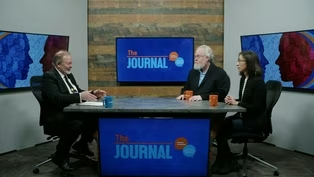
Coverage of State and National Government activities with Dr. Nicole Kalaf-Hughes (BGSU), Dr. David Jackson (BGSU) and Karen Kasler, Host - The State of Ohio
Problems playing video? | Closed Captioning Feedback
Problems playing video? | Closed Captioning Feedback
The Journal is a local public television program presented by WBGU-PBS
March 2026 Government Update
Season 27 Episode 23 | 26m 55sVideo has Closed Captions
Coverage of State and National Government activities with Dr. Nicole Kalaf-Hughes (BGSU), Dr. David Jackson (BGSU) and Karen Kasler, Host - The State of Ohio
Problems playing video? | Closed Captioning Feedback
How to Watch The Journal
The Journal is available to stream on pbs.org and the free PBS App, available on iPhone, Apple TV, Android TV, Android smartphones, Amazon Fire TV, Amazon Fire Tablet, Roku, Samsung Smart TV, and Vizio.
Providing Support for PBS.org
Learn Moreabout PBS online sponsorship(upbeat music) (graphic pops) Upbeat music continues) - Hello and welcome to "The Journal."
I'm Steve Kendall.
We're two months into 2026.
It's time to check in and see what's been going on down in Columbus and in Washington, DC.
We're joined by the Host of The State of Ohio, Karen Kasler, and also from Bowling Green State University, Dr.
Nicole Kalaf-Hughes and Dr.
David Jackson.
So welcome to "The Journal."
Karen, one of the things that has just happened in Columbus, besides all the usual things that go on down there, what the General Assembly is the Epstein files have now made an appearance in Columbus.
There had been talk about Les Wexner, possible mentions in there.
Then it became clear that he was mentioned.
How is that playing out down in Columbus?
Because obviously, he is an important figure in Ohio politics in terms of supporting lots of candidates and lots of causes.
So talk about what the mood is like in Columbus and how that is rippling through Columbus right now.
- As Ohio's richest man, he has been prolific in donating to both Ohio State as well as to various candidates for office at all levels.
Most of his donations appear to be to Republicans, but that doesn't exclude that he's donated to Democrats as well.
And so you have some Republican lawmakers and folks who have gotten money from Wexner over the years, really making it clear they wanna give that money back.
And at first, it was kind of, they were being called on to give it back and then they started coming forward and saying they would give it back.
The the four top executive office holders in Ohio who are all running for a different office now.
So you've got Auditor, Keith Faber, Attorney General, Dave Yost, Secretary of State, Frank LaRose and Treasurer, Robert Sprague.
They all got money from Wexner.
They've all said that they are donating that money.
Yost is the only one not running for another office, and neither is of course Governor Mike DeWine.
He got Wexner money as well, but his campaign account was closed in 2023 since he's not running.
But you've seen folks really trying to distance themselves from somebody who had been a donor, somebody who they had kind of looked at and relied upon as a person who was active in politics in the sense of giving money.
Now, when you turn to Ohio State University in the Columbus campus, the Wexner name is all over the place and most prominently at the Wexner Medical Center, which just opened a 26-story hospital on Sunday.
And so the Ohio Nurses Association has been calling them on them to remove that name.
There was a protest on Sunday in the snow, in the cold from about 150 people saying that Wexner's name needs to go.
So the pressure's really been on Ohio State University in particular to look at this relationship and make a decision.
And they've even gotten requests from the public to remove Wexner's name from various buildings.
- Yeah, and I don't know if these are artifacts of social media, but you have seen places where people have taken chalk and crossed the Wexner name off the medical center, off whatever building it happens to be.
There was a confrontation with a former university president of Ohio by a journalist, and they wanted to talk about his connection with Les Wexner.
So as you said, it's rifling and rippling through all these areas down in Columbus because of the profile that this gentleman had.
- That confrontation was really interesting too because the professor, the associate professor who actually pushed the journalist to the ground, that associate professor works for the Chase Center, which is one of these so-called intellectual diversity centers that were set up by Republican lawmakers as part of this idea of kinda countering what they feel is liberal indoctrination on public university campuses.
And so it was an interesting situation where you had some people who have long said Ohio State is too liberal going after this professor saying that this is proof.
And yet no, the professor actually works for the conservative outfit that has been set up at Ohio State and several other institutions have set up their own center where they focus on constitutional theory and American history and some other things, but with a perspective that a lot of people feel is much more conservative.
- Yeah, and we should note that Bowling Green State University does not have one of those state supported or funded centers like that.
We have our own, but it's not funded through the state.
John Husted, I know too because obviously Sherrod Brown immediately said, "John, you need to do something with that money that Les Wexner gave you."
And he did something with his money too, and basically, I believe donated it to a charity or something too.
So even at at that level now at the US Senate race, it's become somewhat of an issue.
- Yeah, and that last check, Bernie Moreno, the other Republican US Senator has said he did get money, about $3,500 from Wexner, but he had no plans to return it, donate it, anything like that.
But you know, Husted is obviously in this race against former Senator Sherrod Brown.
And so it's come up.
Sherrod Brown has been in office for a very long time and I believe he has some donations in the past but not current.
And in fact, when you look at current donations too, Wexner did not give to either of the two leading candidates for Governor in Ohio, Republican, Vivek Ramaswamy and Democrat, Dr.
Amy Acton.
So he had not involved himself in that race at all and not given any donations there.
- [Steve] Yeah, that's kind of unusual because he generally is involved in pretty much everything.
Now from a political science, perception point of view, is Epstein going to play as a campaign issue in Ohio between Husted and Brown and all these other state offices that Karen mentioned or not?
Does it have any traction right now?
Do we know really?
- [Nicole] My guess is no.
I think you're gonna see a lot of hand waving at this.
I think you're going to see people giving, if they have received campaign contributions, which members of both parties in Ohio and in other states have from Wexner over the years.
He's been a very prolific donor, as has his family.
You'll see some people give their more recent donations to charity.
I don't think it's gonna resonate with voters in a meaningful way unless additional things come out.
- [Steve] Something really, yeah.
More than we've heard.
- Yes.
- [Steve] Not that we've heard so far isn't necessarily bad, but- - Only because he has been tied to Epstein for years.
And it has actually been well known for years that he used Epstein as a financial advisor, contributed to Epstein's involvement in terms of like campaign donations and that kind of thing.
He was involved in that.
We've known about that for years.
That's actually not new information, it's just getting more public play given what has come out more recently.
And I think candidates may try to use it.
I really don't know that it's gonna continue to resonate with Ohio voters.
That being said, if something else awful comes out, right, it could.
But as of right now, I think you're gonna see a lot of hand waving, returning of donations or giving to charity because that way, they get plausible deniability.
And I don't think it's gonna be a major calculus in voter decision making.
- No, okay.
All right.
Yeah, Karen, I mean, is there any other discussion within the General Assembly?
Are people open to discussing this or when they see a reporter coming, are they walking away and going, "Not getting involved in the Wexner thing at all"?
I mean, how is that being treated down there?
- Well, it depends on who you talk to, of course.
But you do have, even some Republican lawmakers, Senator Andrew Brenner has said, you know, this is something that he wants the legislature to look at or wants lawmakers individually to look at.
And then what's interesting to me is Democratic Senator Bill DeMora, who actually represents Ohio State, it's in his district, has said Ohio State really needs to walk away from their relationship with Wexner.
Because they're still suffering from their ties to Dr.
Richard Strauss and the whole sex scandal involving him.
And so there's just been some movement on that front there.
But I think one thing that's interesting to note is when the US House Oversight Committee did come to New Albany where Wexner lives, which is just northwest or northeast of Columbus, and to depose him, it was only the Democrats who came, no Republicans on that committee came.
And Jim Jordan, the Republican congressman is actually the chair of that committee.
He was not here.
Neither was Shontel Brown, who's a Democrat on that committee.
And she's from Cleveland.
But it suggested in a way that Democrats might continue to try to use the Epstein files in general as a topic of conversation and a talking point is we get toward the election.
And I just thought that was interesting to note.
- Yeah, okay.
Good.
Well, we come back, we'll talk more about what's going on in Columbus and regionally as well.
Back in just a moment with Karen Kasler, Nicole Kalaf-Hughes and David Jackson here on "The Journal."
Thank you for staying with us on "The Journal."
Our guests are Karen Kasler, Nicole Kalaf-Hughes, and David Jackson.
David, big Senate race nationally and in the state of Ohio obviously is Sherrod Brown and John Husted.
Where are we at right now with that?
Obviously, we're still downstream from the election a little ways, but what's the status right now of that race?
Who's ahead, is it too early to talk about it?
What's the story with that?
- Oh, it's never too early to talk about it.
All of the evidence suggests that it's going to be an extremely competitive race because just like the thought was last time, the control of the Senate probably comes through Ohio.
I mean, the number in terms of what was spent in 2024 on the Senate race in Ohio, $400 million, something like that, most expensive Senate race, one could anticipate that happening again, probably wouldn't be happening if the Democrats hadn't found for them the one candidate who has the most, you know, serious, you know, chance of being able to succeed in that race.
The polling that's been done by BGSU's Democracy and Public Policy Network is not as recent, but it shows an extremely competitive race.
And the thing to bear in mind when people look at the data from that poll is that it is a Trump plus 10 or 11 electorate.
Because when you do polling, here's a little side note.
In order for the poll to be, you know, valid and reliable, you have to make sure that your sample looks like the population who's actually gonna vote.
And you don't know.
The problem is you don't know who's gonna vote in November - [Steve] Until they vote, yeah.
- You're guessing.
And so the safe choice is made where it came out to look like a lot like the electorate looked in '24.
And that evidence suggests that that Senator, former Senator Brown being competitive is good news for him.
He may not see it as good news because it shows an extremely close race.
But you have to bear in mind that it's a plus 10 Trump electorate.
And the likelihood of the 2026 electorate being Trump plus 10 is pretty low because the midterm elections, are different voters than you see in the presidential election.
And the midterms are often viewed as a referendum on the incumbent.
And President Trump's approval ratings are abysmal right now.
So both models of political scientists suggest are relevant for how to understand midterms.
Either it's different voters in the presidential year or it's a referendum on the incumbent president.
Either one indicates good news for the Democrats, but it is nine months, 10 months, eight months, whatever, away from the election.
- [Steve] Things can change this afternoon.
- [David] Yeah, you know, the $400 million hasn't been spent yet.
And when it does, doesn't matter.
- [Steve] Now is is there a particular issue that seems to be rising and based, I know we haven't, you haven't surveyed recently or polled recently, but is there any indication of what might be the topic if we had to talk about it today?
- Well, I mean, when surveyed, the economy and inflation and general economic matters are the top issues that voters both nationally and Ohio say are the tops for them, are the important issue.
So again, you know, other states and cities maybe can't be extrapolated to Ohio, but you can, you know, do a little bit of that.
And some candidates have been successful other places recently focusing on affordability.
And that's an interesting and successful choice because you have to find, you know, a word and a framing around the message.
And the word affordability is, is like, "Oh, inflation."
Yeah, people know what inflation is.
They sort of do, they sort of don't, right?
Or, you know, the economy in general is sort of amorphous.
Yeah, people want the economy to be better, but if you can distill it to this concept that isn't condescending, like, "Oh, you know, "let's talk about kitchen table issues."
I always find that that's like, you know, you're almost talking down to people when you talk that way.
- [Steve] But affordability sounds- - Affordability.
- [Steve] Everybody can relate to that.
- And there's been some, you know, electoral success with that message.
- Now the 9th District, obviously, is, you know, closer to home for us right here.
Nicole, any thoughts about where that race stands a little bit now?
That's probably an affordability thing too, I'm guessing, although Marcy Kaptur, it's both a benefit probably in somewhat, to some people, a detriment say, "Well, you've been there all that time."
Some people say, "Hey, she's been there, "she's really worked well, she's done all this "for Northwest Ohio."
But then other people go, "Yeah, "but she's been there a long time, so let's change."
I mean, does change always play in this kind of situation?
- There's two schools of thought.
So that race is gonna be a little bit complicated because we haven't had the primaries yet.
There's a lot of Republicans in it.
So we don't actually know who the final, like what the final candidate list is gonna look like.
But that race is really interesting because while Marcy is the longest serving woman in Congress, with that, some people will say, "Oh, you've been there so long, we need fresh ideas."
But also what almost all the political science literature suggests at the federal and the state level is that more experienced legislators are better, they're better at their job, they're more effective, they are better positioned to move legislation through the process, but also to bring back things for their district in terms of federal spending, better able to access like casework stuff for their constituents.
And they just, they know how to do the job.
And that's not necessarily a criticism of new members of Congress, but when you start any new job, whatever it is, you don't know what you don't know yet.
And so the evidence suggests that people who have been in office longer, if they choose to use them, have the skills to deliver for their constituents.
And I think that is something, I don't know that voters necessarily account for that, but that's something that often gets left out of that conversation for people who have a long tenure in office.
- [Steve] Okay.
All right.
Well, we come back, we want to touch on two things.
So we come back, the SAVE Act and then there's another topic that has two S's in it that we're gonna talk about in just a moment.
Sacramento State, which people are probably going, "Why Sacramento?"
We're gonna talk about that in a minute.
Back in just a moment with Karen Kasler, Nicole Kalaf-Hughes, and David Jackson here on "The Journal."
Thank you for staying with us, "The Journal."
Our guests are Karen Kasler, David Jackson, Nicole Kalaf-Hughes and Karen, we were talking about Les Wexner, his donations.
You wanted to clarify something, one of the statements you made just to make sure everybody's clear on what you said and what was accurate.
- Yeah, Sherrod Brown, of course, was in the US Senate for a while.
He got donations from Abigail Wexner, who is Les Wexner's wife, but not directly from Wexner.
And just to add in, you know, Sherrod Brown and John Husted are not facing major primary challenges here.
And so the primary that they're likely to be the nominees for the party.
But I think what would be interesting is to watch what happens in the governor's race.
Because you do have a primary on the Republican side, no primary on the Democratic side.
And some of these other races have been really interesting.
The treasurer's race, you've got a couple of Republicans who are in that.
So the primaries could have some interesting side stories overall I think.
- And they have relevance for Ohio's District 9 because you may remember in District 9 last year, a Libertarian Santa Claus ran and got a lot of votes.
But now that candidate is running for Secretary of State.
So a little slightly different dynamic this time in the 9th.
- Yeah, it'll be an interesting race to watch and obviously important because control of the house is just as important as control of the Senate and that sort of thing.
One of the topics that has been in the news in Ohio, especially and its rolling through the legislative, or excuse me, through the federal government, is what's called the SAVE Act.
And Nicole, could you kind of condense and sort of explain to us what the SAVE Act as currently stands is and what it might be if it should go into effect?
- [Nicole] Yeah, so there are a couple iterations of the SAVE Act.
There's one that's now passed the house.
It is under consideration in the Senate and they're trying to figure out essentially if it's gonna come up for a vote or a filibuster.
But what it would do, it would actually impose federal requirements on elections.
What makes this really interesting is the Constitution explicitly says that states determine the time, place, and manner of elections.
So it is entirely a state purview and this runs directly like in the face of that.
And what it would do is it would impose really strict registration requirements that states would have to enforce and additional like voter role documentation things.
And what makes it so controversial relative to some of our other voting legislation is that it actually requires like documented ID, like your birth certificate or a current US passport, to register with your current name.
Many people in the United States, if they've gotten married and changed their name, their documents don't act, their birth certificate doesn't reflect that.
About a little over half of Americans do not have a valid passport.
And so that would require them, if they move and have to re-register or anything like that to use their birth certificate.
If their birth certificate does not match their legal name, which mine doesn't because I got married and I hyphenated my name as did my husband, then you would need to essentially find a way to register and states are going to have to figure that out if it passes.
The other problem here is that this is tremendously expensive and there is no money for this for the states, nor do they have the technology to verify birth certificates or other types of documents like a passport from across the country.
And so it really puts a burden on the state.
And one of the things that you could end up with is a bifurcated electoral system where state elections have one requirement, federal elections have another, and Arizona is currently doing that right now because so many of their laws are in the courts.
And so the voting pool may be very different based on whether you're voting in a federal election and a state election.
And the final thing I'll say on this, because I could talk forever about this, is what we know is that anytime you make it harder to vote, fewer people vote.
- [Steve] Vote, sure.
- And so it is not something that is expanding the franchise.
It's not something that's making it easier for Americans to vote.
We have statistically zero voter fraud in the US.
There is no statistically significant voter fraud in the United States.
So this is kind of a solution in search of a problem.
And even when people have to wait in line to vote, they're less likely to turn out next time.
There's a lot of political science research on this.
So anything that makes it harder is gonna reduce your voting pool and disenfranchise millions of American citizens.
- Which would seem to be the opposite of what we've been trying to do for years is get more people to show up and vote.
So yeah, okay.
All right, probably a topic that most people that we, you know, if we had to predict a topic 10 years ago that we might be doing sometime on the show, Sacramento State University from California is going to become a member of the Mid-American Conference in football, which means Bowling Green, Toledo, Miami, Ohio U, I'm gonna leave somebody out, Akron, used to be Northern Illinois, but they're leaving to go to the Mountain West.
So talk to us about Sacramento State.
Obviously you have a connection to Sacramento State in a roundabout way.
- I do.
I'm a very proud alum of UC Davis.
And for years, UC Davis' main rival in athletics was Sacramento State, similar to the BGSU/UT rivalry and the Battle of I-75, Sac State and Davis had the Causeway Classic, they're about 20 minutes apart and part of different university systems, but both in California and for 71 years, they had the Causeway Classic football game.
And this fall was the most recent one and it was the last one because Sac Sack state is apparently leaving the conference to pay a lot of money, which Dr.
Jackson can talk about, to join the MAC.
So as a proud Davis alum, I'm excited about the possibility of getting to, you know, heckle my Sacramento colleagues.
But it is an investment for the the school.
- [Steve] And talk about, because when you first see it, like Sacramento State playing Miami of Ohio, that's a normal thing.
- [David] Or UMass.
- [Steve] Or UMass, yeah.
Yeah, you can literally travel from coast to coast.
So talk about, yeah, your point about Sacramento State.
- Well, I mean, college athletics and college football in particular are just getting crazy and it's affecting us here at BGSU.
You know, the arms race that's going on.
Based on the latest financial reporting, our athletics budget is now approaching $36 million, 14 million of that comes from mandatory student fees, but another $8 million of that comes from direct institutional subsidies.
So if our athletic programs had to exist just on the revenue that they generate, they would lose $22 million a year.
The student fees, of course, get the students free admission to the sporting events.
And that probably would be argued by the university contributes, you know, to our recruiting and retention and the successes that we have.
The $8 million in direct institutional subsidies are dollars that the university, and that's just one year, could spend on anything they wanted to spend that money on, any priority they wanted to choose.
And recently, the university has made some choices in terms of their priorities and I just thought it was important to note, the financial arms race, that even, you know, the little Mid-American Conference, the old Little Big 10 as they used to call us, are now engaged, yeah.
- [Steve] Part of, yeah, kinda like being Argentina in World War II kind of, but still involved and still having to be involved in it, yeah.
Well, and the important, I think the discussion too, the discretionary funding is probably as important as anything else because as you said, that could be directed to any other thing on the university campus.
The university has chosen to say $8 million for athletics.
So yeah.
Okay, good.
And then we'll see how Sacramento State does in football in the Mid-American Conference, you know, so it'll be interesting.
So you guys know this, we talked about it.
This is our last program.
"The Journal" is being eliminated due to cuts in federal funding.
And I just wanna say you guys have been doing it for 10, 12 years now, and I appreciate the fact that you've brought an incredible amount of insight into the political world and just the cultural world that we deal with every day.
And Karen, obviously, your connections in Columbus have been extremely important to illuminate the things that go on down there.
So I just wanted to thank you guys particular for being here whenever I called and emailed and texted and said, you know, "Yeah, how about Monday at 9:30," which is always a fun time for everybody.
So I appreciate that very much.
So thank you again so much.
Appreciate it.
Over the last 16 years, more than 500 shows, you've invited us into your homes and for that we thank you.
We covered a wide range of topics during that time in an attempt to provide insight into the world around us.
And while some of you didn't always agree with what was said or what was presented, our goal is always to illuminate and inform with the idea that the more we know about a topic and each other, the more likely we are to better understand each other and find common ground on those issues that some are using to try to divide us.
We hope that in some small way, we succeeded.
Again, thank you so much.
72 years ago, this country faced a crisis of character and conscious.
And as someone said then, we must not confuse dissent with disloyalty.
We must remember always that accusation is not proof and that conviction relies on evidence and proof and due process of law.
We should not be driven by fear into an age of unreason.
And remember that we are not descended from fearful people, not from people who fear to write, to speak, to associate, and to defend the causes that were for the moment unpopular.
You can check us out at wbgu.org and one last time Thursday at 8:00 p.m.
on WBGU-PBS.
And for one last time, good night and good luck.
(upbeat music) (upbeat music continues)
March 2026 Government Update- Preview
Preview: S27 Ep23 | 30s | Panel Discussion of state and national government activities. (30s)
Providing Support for PBS.org
Learn Moreabout PBS online sponsorship
- News and Public Affairs

Top journalists deliver compelling original analysis of the hour's headlines.

- News and Public Affairs

FRONTLINE is investigative journalism that questions, explains and changes our world.












Support for PBS provided by:
The Journal is a local public television program presented by WBGU-PBS