
January 2026 Government Update
Season 27 Episode 19 | 28m 3sVideo has Closed Captions
A look at what's happening in our state government and federally at the start of 2026.
A look at what's happening in our state government in Columbus and federally in Washington DC as we start 2026.
Problems playing video? | Closed Captioning Feedback
Problems playing video? | Closed Captioning Feedback
The Journal is a local public television program presented by WBGU-PBS
January 2026 Government Update
Season 27 Episode 19 | 28m 3sVideo has Closed Captions
A look at what's happening in our state government in Columbus and federally in Washington DC as we start 2026.
Problems playing video? | Closed Captioning Feedback
How to Watch The Journal
The Journal is available to stream on pbs.org and the free PBS App, available on iPhone, Apple TV, Android TV, Android smartphones, Amazon Fire TV, Amazon Fire Tablet, Roku, Samsung Smart TV, and Vizio.
Providing Support for PBS.org
Learn Moreabout PBS online sponsorship(upbeat music) (graphic pops) (upbeat music) - Hello and welcome to "The Journal."
I'm Steve Kendall.
What's going on in Columbus, in the state, what's going on in Washington D.C.
as we start the new year?
Joining us, the Host of the State of Ohio, Karen Kasler.
Also Dr.
Nicole Kalaf-Hughes, and Dr.
David Jackson from Bowling Green State University.
Welcome all of you to "The Journal."
A lot has changed since we talked the last time.
There was speculation about the Governor's Race, who would be the lieutenant governor candidates, et cetera, et cetera, and that's sort of fallen into place.
So, Karen kind of bring us up to speed.
Acton has selected her lieutenant governor, a running mate, Ramaswamy has, and then we've got another guy who not a lot of people know about who's entered kind of as a side candidate, but so talk about what's going on in Columbus with regard to how people are viewing Acton, Pepper, Ramaswamy, McColley.
- Yeah, we got the running mates on the same day essentially, because Vivek Ramaswamy had planned an event in Cleveland where he told VIPs in an invitation that he would introduce his running mate who was Senate president, Rob McColley.
Not a huge surprise.
A lot of people saw that as a real strong possibility for him to select McColley.
Even though the event was in Cleveland, I think a lot of people thought that if he picked McColley, it would be in Northwest Ohio.
But that's what ended up happening.
And on the same evening that that kind of leaked out, Dr.
Amy Acton's choice of running mate leaked out as well.
And that's former Ohio Democratic Party chair, David Pepper.
She introduced him first on the next day, just the way the schedules worked, at an event in Columbus that was designed to be a round table talking about affordability, but it was the first appearance for her and David Pepper together.
Pepper, again, former Democratic Party Chair for Ohio, but also has run statewide twice and lost.
He's got a pretty big social media profile, and so McColley has served in the House and Senate as well.
And so you've got two outsider candidates who've never been elected to a public office in the top ticket, you know, Ramaswamy and Acton.
And then two people who are, their running mates who have some experience running statewide and in McColley's case actually being in the legislature.
And then you mentioned the other candidates, Casey Putsch is his name.
He's running to the right of Ramaswamy.
So, Ramaswamy will have a primary, and he has selected, as his running mate, a woman named Kim Georgeton.
And she is from Southwest Ohio, a former Moms for Liberty Chapter Chair who had an anti-mask, an anti-vaccine organization.
So, he's definitely running further to the right, the Ramaswamy, trying to pick up votes from people who wanna abolish property taxes and some other issues.
- Mm, yeah, and Nicole, when you view that, is there a reason why, and I think Karen touched on that, was that the purpose, to find a kind of a complimentary person to these two outsiders and then the third person who is an extreme outsider?
- [Nicole] Yeah, so both of our kind of major party, like endorsed gubernatorial candidates in Ramaswamy and Acton are not what I would consider traditional gubernatorial candidates.
They don't have a long political history in statewide elected office.
They haven't served in really any elected office previously, and that's pretty unusual for the Office of Governor.
Additionally, they are not white men, which the majority of our gubernatorial candidates and our elected officials nationwide are white men.
And so they've both kind of heard some pushback from kind of the extremes on that.
And so picking kind of more traditional, experienced running mates is definitely what I would expect.
As far as the additional candidate on the Republican side, that I think also makes a lot of sense.
Ramaswamy has actually taken some heat for both race and religion, and not being in line with what some feel Ohioans want for the Republican Party.
And so seeing a further to the right challenger enter, I kind of expected that to happen.
I think it was really unusual for Ramaswamy to get the endorsement so early from kind of the federal administration.
And so I think having a candidate running to the right of him is probably something that was likely to happen, given what we know about politics.
- Yeah, and the other thing is too, I guess David with Mr.
McColley, he's rooted in Ohio, Northwest Ohio, Napoleon, Ohio.
There was some thought possibly that there was a reason why he may or may not have gone for lieutenant governorship, but I heard someone from the Republican Party talk about the fact that they believe there's a lot of ground to gain in Northwest Ohio.
In essence first said, "We're writing off the three Cs.
We're not gonna worry about those."
We think he's the right choice because he'll bring more votes from Northwest Ohio.
That could be the difference in a close race.
And I'm not, that's their version of it.
What do you think about why McColley is there?
- Well, up here in occupied Michigan or what we call Northwest Ohio, (laughs) (Steve laughs) there is a sense of always being sort of, you know, left out and not considered.
And there was even, you know, a tiny bit of ground swell, if you could even barely call it that, suggesting that Toledo Mayor Kapszukiewicz, should be Acton's running mate, "The Blade," in "Toledo Blade" newspaper can always be counted on to find a Northwest Ohio angle and try to push the Northwest Ohio angle on things.
But that didn't happen obviously.
It also, you know, has a Northwest Ohio implication in that the ninth district currently held by Representative Marcy Kaptur was redrawn to include much of Senator McColley's - [Steve] Ah.
- State Senate district.
And there was speculation that he would jump in the primary there with Representative Williams and former Representative Merrin on the Republican primary's side because the district is, you know, favors Republicans.
And so there was some thought that that might happen, but that didn't happen.
And I'm sure that that's probably good news from, you know, the Williams' and Merrin's side of things, - [Steve] Right.
- to make it through that primary.
- [Steve] Yeah, because I was gonna ask, yeah, oh, sorry, - [Karen] I'm- - [Steve] go ahead Karen.
- [Karen] I have- One thing really quick.
- [Steve] Sure.
- I think for a lot of people, the idea of a lieutenant governor candidate bringing in votes is potentially a little bit less of a reason why they pick, - [Steve] Yeah.
- some people as running mates, because people tend to vote for the person at the top of the ticket rather than the running mate.
But certainly if a running mate hurts you, that could be a problem.
And I think that's potentially one reason why these candidates were selected is that they do have that political experience, so they're unlikely to damage or do anything that's going to hurt the campaign of Ramaswamy and Acton.
- [David] Yeah, I mean, people don't vote because of the vice presidential candidate.
They certainly therefore do not vote because of the lieutenant governor candidate, - [Steve] Lieutenant, mm-hmm.
- The lieutenant governor candidate, you know, as Karen pointed out, has to sort of pass the laugh test, you know, are they a serious candidate?
And I suppose in a more realistic sense, people might say, "Can this person conceivably be governor?"
If yes, then they don't think about him again, probably, (chuckles) yeah.
- Yeah, yeah, so.
And not to go back and revisit history, but I guess if you looked back at John McCain, did his choice for vice president impact him negatively or positively?
That's been a question that's been written about a lot, but that could be a case when we say, "That could have been a problem, that could have been a drag rather than a benefit."
So, as I think as one of you said that as long as you don't damage the campaign, that's your job, sort of, so, yeah.
- [David] And then on this - [Steve] Yeah, yeah.
- [David] other Republican candidate, one thing, I mean, - [Steve] Mm, yeah.
- [David] the probability is low that he's gonna, you know, win the nomination when the entire state, you know, party machinery is pushing in the other direction, but what percentage ends up getting could be an interesting signal if Ramaswamy is in trouble, - [Steve] Mm-hmm.
- with the base or not.
You know, if he's getting into double figures, - [Steve] Yeah.
- or more, yeah, that could be a sign of trouble.
- Okay, when we come back, I have one question I wanna ask about that after the primary, which you touched on a little bit.
Back in just a moment with Karen Kasler, Nicole Kalaf-Hughes, and David Jackson here on "The Journal," back in a moment.
- Thanks for staying with us on "The Journal."
Our guests are Karen Kasler the Host of the State of Ohio, Dr.
Nicole Kalaf-Hughes, Dr.
David Jackson from the Political Science Department, Bowling Green State University.
Karen, real quick, we're talking about this other candidate Casey Putsch, he's gonna run in the Republican primary.
Clarify something for us, if he finishes second, or whatever, could he then turn around and run as an Independent or does Ohio law prevent him from doing that?
If he doesn't make the Republican nomination, can he turn around and say, "I'm gonna run as an Independent?"
Can he do that or not?
- Well, we've seen that actually happen in terms of a candidate having a contested primary.
Mike DeWine who won 2022, I have pretty large margin, had two opponents in the primary, and neither of them of course ran because candidates for the general election need to file by February fourth.
So, no, he could not run as a candidate for the Libertarian Party or anything like that.
What he could do is he could run as, and any candidate could, as a write-in candidate, and they have to be officially write in or else the vote for them doesn't count.
He'd have until August 24th to file that paperwork.
So, it's possible, but he wouldn't be a candidate.
We have a Sore Loser law essentially in Ohio.
You can't run for an election and then if you lose, say, "Well, I'm gonna run again, but on a different party."
- [Steve] Yeah, okay.
So, and the odds on him being successful as a write-in are pretty limited.
Should that be exempt?
- [Nicole] Pretty low, particularly because he's coming from so far outside politics broadly, when we've seen write-in candidates be successful, usually they're incumbents.
It's not someone who is coming from so far outside of the political, like the typical political spectrum to jump in.
- Yeah, yeah, and write-ins traditionally, David, I'm sure have not been successful probably in many places around the country.
because you're starting from below ground zero almost in a way.
- Yeah, there's a low chance of that succeeding.
Although, I mean, it is an interesting situation with this candidacy because I've been following social media posts from the State Republican Party promoting Ramaswamy, and it's not been, you know, a systematic or rigorous analysis, but it's interesting what's happening in that, the comment section.
- [Steve] Mm.
- There's a lot of opposition in the Republican base to Ramaswamy.
- [Steve] Mm?
- And that's always been there when the posts are made.
Now, when the posts are made because of the other candidate, the comments are both negative about Ramaswamy and putting links in connections, trying to, you know, tout that candidate.
- [Steve] Ah.
- And then the third thing that's been popping up a lot as well is whatever candidate says they'll ban property taxes is somebody, - [Steve] Mm-hmm, yeah.
that I can get behind.
- [Steve] Mm-hmm.
- And so it's a interesting stew of opposition to the chosen candidate.
Now, a connection with an option against the chosen candidate, and a specific issue (chuckles) that they want, - [Steve] Mm-hmm, mm.
to draw the line.
- They would- - Right, yeah, so.
- [Steve] Yeah, yeah, and Karen, well, guess we can talk about that.
There's been a lot of activity.
You've had David Thomas on your show numerous times to talk about the things they put in place to start to provide some property tax relief.
Most of it doesn't happen until 27, when it'll start to show up theoretically on people's property tax payments.
But property tax abolition, there's a movement out there, there's a citizens' initiative.
What's the undercurrent in Columbus about that?
Is the legislature general assembly working to figure out a way to head that off by trying to do some of the things that Dave Thomas put out there?
Or is that still, they're not done working on it yet, I guess is what I'm asking?
- Yeah, there are more than 50 bills that are out there, - [Steve] Yeah.
- that specifically reference property taxes.
And some of them are bills we've seen before, like the homestead tax exemption expansion and also the circuit breaker that would trigger a property tax cut at a certain level of income.
Those have bipartisan support and those have not moved.
But those are two that are sitting out there.
The Abolishment group, they're active on social media, but I always try to remember that social media is not reality.
And the group that's out there that is very clearly abolishment, that's all that they will accept, I think is a fraction of the overall population.
There is significant frustration with property taxes, no question.
But you're already starting to see some folks talk about the need for property taxes to fund schools and law enforcement, and all the things that property taxes pay for.
And if you just get rid of that, then the chaos that would result is pretty significant.
And so the Republican leadership in the State House has been talking about that part of it, saying that we're doing these things and if you abolish, it will be something that we won't be able to handle.
So, I think we're gonna see more of that going forward.
- Yeah, and real quick, has anybody brought forward a plan down there as an alternative to property taxes?
Because that's the question people ask is like, "Well, okay, if I don't have this funding, where's it going to come from?"
But probably the General Assembly doesn't wanna open that door.
Because then people will say, "Well, there is an alternative then," so- - Well, but, there has been a couple- - [Steve] Has there?
Okay.
- You know, a state sales tax, expansion of the state sales tax, you know, a statewide 20 mill property tax.
But you know, these are ideas that are in that 20 bill or that 50 bill mix of property tax reform ideas - [Steve] Mm.
- that I don't know that they're going to get a whole lot of traction because that would be wholesale changes to what Ohio does right now.
- [Steve] Yeah.
- [Nicole] Well, and the estimates where from, like from like Ohio's economic data, if you were to get rid of property taxes, not only are townships entirely funded by property tax, and there's no alternative plan for where they would get their money from, but the estimates are that you would need about a 20% sales tax - [Steve] Mm.
- to make up from losing property tax.
- [Steve] Yeah.
- So, it's the people who are looking to abolish property tax have not actually answered those questions of how people would afford a 20% sales tax, and what the thousands and thousands and thousands of Ohioans who live in townships and the townships that rely on those property taxes, what replaces those funds.
- [Steve] Yeah.
- And there just really isn't an answer to that because the group doesn't really seem to have one yet.
- Yeah, and I think too, and as you read social media, because once you start to read those, and they, "Oh, look, there's a 1000 comments," and some will say, "Well, we don't want you to, no increase in the sales tax, no increase in any taxes, do away with all of them."
And then I had to laugh once because someone said, "Well, where's the money come?"
Says, "You can just get that from grants."
Well, I'm pretty sure grants come from taxes.
Pretty sure, so, but, - [Karen] Well, and I- - it shows you the array of like what's out there on the whole tax thing, no taxes at all.
And yet I want everything paid for that I still have.
So, yeah.
- [Karen] The one thing I would say is, - [Steve] Yeah.
- if this effort is successful, which they need over 400,000 signatures - [Steve] Yeah.
- and they're all volunteers.
So, that's a big hill to climb.
If indeed they do make the ballot, you're gonna see a real wholesale education campaign on how government works.
Because one of the things I found out in looking at some of these comments on social media is a lot of people don't really understand how government works and specifically state government.
- Yeah, yeah.
And I think that's that's true.
I mean, and I guess, you know, and that's probably not unusual because people go about their daily lives.
They don't worry about how the snowplow gets paid for, or why the fire department shows up when there's a fire.
They just know that it's supposed to happen.
- [Nicole] Well, and the other thing - [Steve] Yeah.
- [Nicole] that people forget is that you can get rid of property taxes and you can then in turn get rid of your fire departments and your police force and all that, and go to volunteer fire service and rely on county sheriffs.
But the problem is that your insurance company will know all of that and your homeowner's insurance will skyrocket.
So, what you're not paying - [Steve] Yeah, mm-hmm.
- in property taxes, you'll be paying in insurance because your insurance company is not going to look at the facts and be like, it'll probably be fine.
- [Steve] Mm-hmm.
- They'll know that any small fire you have will be a total loss.
- [Steve] Right.
- And they will charge you accordingly.
- [Steve] Yeah, yeah.
- [David] I mean the other thing is, - [Steve] Yeah.
- [David] these property tax rates are voted on by the public.
So, an option would be to, - [Steve] Say no.
- Say no.
(chuckles) - [Steve] Yeah, yeah, and that started to happen to some degree.
- [David] Sure, sure.
- But yeah.
But that, yeah, that's been the check and balance.
That was the local level control was that, but apparently some people don't think that's working the way it should.
And you see things too, and I know we've gotta run here, get outta this segment real quick, but some people have said only property owners should vote on property taxes, which that's a whole nother thing that deals with how the country looked at who could vote to begin with, so, - [David] Renters pay property taxes.
- [Steve] Yeah, yes, they do.
It gets billed into their, yeah.
So, yeah, we'll be back in just a moment with Karen Kasler, Nicole Kalaf-Hughes, and David Jackson here on "The Journal."
- Thank you for staying with us on "The Journal."
Our guests are Karen Kasler, and Nicole Kalaf-Hughes, and David Jackson.
We were talking about this last year long before it became a thing, but now the '26 midterms are actually the year 2026.
Karen in Columbus, obviously you've got people jockeying for different things down there.
How is that being viewed, the overall look in Ohio now?
We do have congressional districts in place.
Is that sort of now quieted down in Columbus with regard to what's gonna happen in the '26 midterms?
Or is there still a lot of activity down there talking about that?
- Well, I think there's activity in the sense that February fourth is the filing date, which we talked about earlier.
Lawmakers aren't here right now.
They're on a little bit of a break.
I think they're supposed to come back, One Chamber's gonna come back at the end of January.
And so, there aren't a lot of people around.
(laughs) - [Steve] Yeah, okay.
- But, and that's, I think that's, you know, in the sense they did accomplish a lot of stuff before the holiday break.
And also there's the getting prepared to run, because you got the entire Ohio House, half the Ohio Senate, all 15 members of Congress are running.
You've got two Supreme Court seats.
You've got, obviously we've talked about the governor's race, but also that US Senate race, which is gonna be pretty high profile.
It is unusual for an appointed senator who has not run for that siege to go up against a former senator who wants to come back.
- [Steve] Yeah.
Yeah, that's a good point because Sherrod Brown, obviously, well entrenched in Ohio, and came very close to winning even for his reelection term.
So, how does that play out now, as Karen said, we've got someone who has never been elected but now is running against someone who previously held that seat.
- I think we're gonna be back to a very public campaign, and I think there's gonna be a lot of nationwide attention on Ohio.
What's interesting is that when we've had these gubernatorial nominations of people to kind of serve in a Senate seat when someone leaves for another reasons, they actually haven't won in Ohio recent history.
They have not won the reelection when they've run.
I don't know that that's gonna be the case again necessarily, but it's not a lock, I think, - [Steve] Yeah.
- like you don't have that historic lock.
- [Steve] Yeah, yeah, yeah.
- Well, as we talked about before, I mean, in some measures except for the ultimate measure, which is winning the election, Sherrod Brown's electoral performance, - [Steve] Was above the- - in 2024, (Steve clears his throat) was actually pretty impressive given that he had 11 point-plus Trump headwinds, and only lost by three.
And you know, you wonder if, you know, the Harris campaign had spent a little money in Ohio just to not try to win it, but to tamp down the number of that, yeah, could have helped.
So, now Brown is obviously thinking without Trump on the ballot, how does that impact, you know, who actually turns out.
- [Steve] Mm.
- He's running against an opponent who is not a household beloved name in Ohio.
- [Steve] Right.
- Actually, you know, survey evidence shows that Sherrod has higher name recognition than - [Steve] Than the current senator.
- Jon Husted does.
- [Steve] Yeah.
- And so, and there's gonna be a huge amount of money.
I think 2024 was one of the most, if not the most, - [Nicole] it was the most expensive- - expensive, yeah.
expensive Senate race ever.
And, you know, Ohio may not be a swing state presidentially right now, but the control of the Senate probably goes through Ohio again.
- Yeah, and now Husted, although obviously he had a track record at the state level now has a track record as a US senator, which may or may not be used against him or for him.
He's gonna tout the things that he did obviously.
Brown's gonna say, "Yeah, but look at what you didn't do or what you should have done."
He now has a record as a senator, which he didn't have before.
- [David] I mean the political climate overall is interesting right now.
And I'm thinking about, trying to think of a way to write about this as a, you know, political scientist.
The public is just upset and angry all the time it seems, and in an anti-incumbent mood and not happy with the way things are going.
In Ohio, the Republican Party has been dominant and in charge for a long time and are running a campaign that occasionally talks about how things need to be done to improve Ohio.
- [Steve] Yeah.
- That Ohio needs to be, you know, changing its direction.
And it's gotta be a really tough situation to frame a campaign when you've been in charge for decades, - [Steve] Yeah, yeah.
- and the people aren't happy with what's going on.
So, you need to try to present yourself as the entrenched to, you need to, you are the entrenched incumbents and you're trying to present yourself as the agents of change.
- [Steve] Mm, mm-hmm.
- And that's not an enviable position for campaign strategists to be in.
- Yeah, and I know, and again, we're talking about the unreal world of social media, when I look at comments.
When people talk about the current people running Ohio, they see them as not really being Republicans, some people.
They go, "Well, they're not really Republicans, they're rhinos, that's why they have to go."
So, on one hand, they're able to walk away from it because the people that don't like them are saying, "You're not really Republican anyhow, so don't blame the Republican Party for what the Republicans have done to Ohio."
It's kind of an interesting, because those weren't real Republicans.
- [David] Well, I mean, so- - [Steve] So, that which is a personal, it's a, you know, it's an opinion, it's a reaction to that, but yeah.
- [David] It's a cliche, but I mean, elections are choices and they're not choices between an ideal and an ideal, they're a choice between two real candidates who have a chance of winning.
- [Steve] Yeah.
- And so, you know, those who say the current Republicans are only rhinos will have to make a choice.
Do they hold their nose and vote for them, or do they vote, you know, third party, or do they stay home?
And same thing on the other side, - [Steve] Yeah.
- you know, that dissatisfaction that voters have has to get resolved when the choice is between two, by their perception, flawed candidates.
- Yeah, yeah.
And Karen is, with the General Assembly, is there a feeling there's going to be people leaving the General Assembly to do either, to run for some other office or just leave because of the political climate?
Or is there any feel for that down there right now?
- I haven't seen any wholesale departures.
- [Steve] Okay.
- I mean, obviously, - [Steve] Okay.
- in Congress we've seen some, but I would also argue that it's not just a choice, it's a binary choice in many ways when it comes to elections, because one person's going to win.
And you have people who try to vote third party, especially in general elections to try to send a message, or that sort of thing.
You're really choosing between the two most likely candidates.
And either you choose one or you kind of aren't voting, you're not really doing anything to support one or the other candidate.
- Yeah.
Yeah.
And I guess if you look at Ohio, because obviously it is interesting because the state is, as you said, David, has been controlled at, like, I've heard numbers like, except for four years outta the last 30, the Republicans have controlled most of the machinery of state government.
And yet there is that unrest, there's that concern that they haven't done enough.
And yet the alternative is to look at the other party, which apparently people have not been inclined to vote for the last 30 years.
So, to some extent it leaves you with an interesting choice, but yet they're not happy with their current people and they're not happy with the opposition.
So, could be really entertaining as it comes down to this.
And I guess we'll see some of that play out in the primaries because a lot of, generally, a lot of people are gonna get primary, it appears, so.
Is there any, Karen, is there anything down there just that you could say, "Hey, here's the next big issue that's gonna pop in 2026," besides the election rigamarole.
Is there something they're really focusing on, or is it they're too busy worried about getting reelected?
- [Karen] I think property taxes is gonna be it.
- [Steve] Yeah.
- I mean, as those start to hit in late January and early February, you're gonna start hearing people complain again about property taxes.
- [Steve] Mm.
- And again, the whole idea of abolishment is extreme, but it's out there, it's being discussed, and lawmakers are gonna have to push back on that and defend themselves while still saying, "Hey, yeah, we feel for you with how much you're paying in property taxes."
So, I think that's gonna be continuing in from 2025, the big issue.
- Yeah, and as you said earlier, I think David or one of you, that that could be the tipping point on whether somebody votes for Casey Putsch, or they vote for Vivek Ramaswamy, because Putsch is very much, I believe, citing on the, like, we need to do a lot to get rid of taxes, do whatever we can.
And that's, some people are saying, "That's my tip, that's my single issue.
I'm a single issue voter."
A couple of years ago it was abortion, it was this, whatever, now it's property taxes.
So, may be the big word for the pair of words for 2026.
- [Nicole] It's really easy to make promises like that during a campaign and a lot harder to actually deliver on it.
And this is one of the reasons that voters broadly are so dissatisfied because to get elected in the US you have to make so many promises about what you're gonna do, what you're gonna change.
But the actual way government works isn't usually that fast and you usually can't work alone.
And so, if you've made all these large promises about taxes or something else, and you don't immediately make the changes, voters tend to look elsewhere.
Or it's very easy for your potential opposition to encourage them, - [Steve] Yeah.
- to look elsewhere.
- [Steve] Okay, well, we'll leave it there and we'll see when we talk the next time, what's transpired between now and then, so, we'll... Because obviously there'll be a lot of activity, the General Assembly will be back, and let the fun begin, I guess.
You can check us out at wbgu.org.
You can watch us every Thursday night at 8:00 PM on WBGU-PBS.
We'll see you again next time.
Good night and good luck.
(upbeat music) (graphic pops) (upbeat music continues)
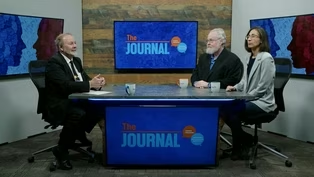
January 2026 Government Update- Preview
Preview: S27 Ep19 | 30s | A look at what's happening in our state government and federally as we start 2026. (30s)
Providing Support for PBS.org
Learn Moreabout PBS online sponsorship
- News and Public Affairs

Top journalists deliver compelling original analysis of the hour's headlines.

- News and Public Affairs

FRONTLINE is investigative journalism that questions, explains and changes our world.












Support for PBS provided by:
The Journal is a local public television program presented by WBGU-PBS