
Climate: Climates Over Time
Clip: Special | 1m 4sVideo has Closed Captions
How has the Earth’s climates changed over time?
The Earth’s climate has changed a number of times over millions of years. What was the Earth like when dinosaurs roamed? When the first peoples came to the Americas, how cold was it? What was the Dust Bowl? Find out how Earth’s climate has changed over time.
Problems playing video? | Closed Captioning Feedback
Problems playing video? | Closed Captioning Feedback
Science Trek is a local public television program presented by IdahoPTV
Major Funding by the Laura Moore Cunningham Foundation and the Idaho National Laboratory. Additional Funding by Sparklight, the Friends of Idaho Public Television and the Corporation for Public Broadcasting.
Climate: Climates Over Time
Clip: Special | 1m 4sVideo has Closed Captions
The Earth’s climate has changed a number of times over millions of years. What was the Earth like when dinosaurs roamed? When the first peoples came to the Americas, how cold was it? What was the Dust Bowl? Find out how Earth’s climate has changed over time.
Problems playing video? | Closed Captioning Feedback
Where to Watch Science Trek
Science Trek is available to stream on pbs.org and the PBS app.
Science Trek
Science Trek is a place where parents, kids, and educators can watch short, educational videos on a variety of science topics. Every Monday Science Trek releases a new video that introduces children to math, science, technology, engineering, and math (STEM) career potentials in a fun, informative way.[MUSIC] JOAN CARTAN-HANSEN, HOST: The Earth's climate has changed a number of times over millions of years.
When dinosaurs roamed the earth, about 250 to 60 million years ago, the earth's average temperature was about nine degrees warmer than it is today.
But after that, the earth had a series of ice ages.
When the first peoples arrived in the Americas between 15 thousand and 30 thousand years ago, much of the continent was covered with ice sheets two feet thick.
Between 1300 to 1850, the northern hemisphere experienced a little ice age.
Crops in Europe failed because temperatures were so cold.
Other parts of the world have experienced droughts or a lack of rain and snow.
Between 1934 and 1937, parts of America's Midwest suffered a drought known as the Dust Bowl.
Rolling clouds carried soil away and crops failed so people had to leave.
When climates change, plants, animals and even people can have a hard time adapting.
For more information about climates and climate change check out the Science Trek website.
You'll find it at science trek dot org
Video has Closed Captions
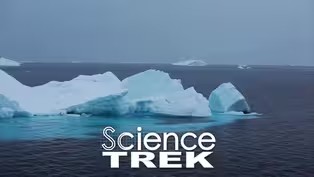
Clip: Special | 1m 4s | What is a gigaton and why are the ocean levels rising? (1m 4s)
Providing Support for PBS.org
Learn Moreabout PBS online sponsorship
- Science and Nature

Explore scientific discoveries on television's most acclaimed science documentary series.

- Science and Nature

Capturing the splendor of the natural world, from the African plains to the Antarctic ice.






 New Episode
Support for PBS provided by:
Science Trek is a local public television program presented by IdahoPTV
Major Funding by the Laura Moore Cunningham Foundation and the Idaho National Laboratory. Additional Funding by Sparklight, the Friends of Idaho Public Television and the Corporation for Public Broadcasting.