
Appraisal: Hopi Kilt & Katsinas
Clip: Season 29 Episode 10 | 3m 40sVideo has Closed Captions
Appraisal: Hopi Kilt & Katsinas
Watch Ted Trotta appraise a Hopi kilt & Katsinas in Denver Botanic Gardens Chatfield Farms, Hour 1.
Problems playing video? | Closed Captioning Feedback
Problems playing video? | Closed Captioning Feedback
Funding for ANTIQUES ROADSHOW is provided by Ancestry and American Cruise Lines. Additional funding is provided by public television viewers.
Support provided by:


Appraisal: Hopi Kilt & Katsinas
Clip: Season 29 Episode 10 | 3m 40sVideo has Closed Captions
Watch Ted Trotta appraise a Hopi kilt & Katsinas in Denver Botanic Gardens Chatfield Farms, Hour 1.
Problems playing video? | Closed Captioning Feedback
Where to Watch Antiques Roadshow
Antiques Roadshow is available to stream on pbs.org and the PBS app.
Buy Now

ANTIQUES ROADSHOW's 2026 Production Tour
Enter now for a chance to win a pair of free tickets to one of the three stops on ANTIQUES ROADSHOW's 2026 Tour. Sweepstakes entry deadline is April 6.Providing Support for PBS.org
Learn Moreabout PBS online sponsorshipGUEST: A friend who knows a lot about weaving and Native American art told me that this is probably a Hopi man's ceremonial kilt, and perhaps late 1800s.
My father-in-law bequeathed these to me in 1998.
There is a, a manuscript that, uh, includes my, my mother-in-law about a trip to Mexico.
It was 1937 or 1939, somewhere around then.
APPRAISER: Well, that's very helpful.
That would suggest these were circa 1930s.
GUEST: Okay.
APPRAISER: They are Hopi, they're from Arizona.
And the man's kilt, it's late 19th century.
The foundation is hand-spun cotton.
The embroidery is wool, and this would have been wool raised by the Hopi.
The red is an aniline color, that's a commercial dye... APPRAISER: ...that would have been acquired in trade.
At the top is a natural brown wool.
The light blue-green is indigo, and then the, the black is sort of an enhanced brown.
And the kilt was worn ceremonially, and it was worn by men doing-- I'm going to change the terminology from kachina to Katsina...
GUEST: Oh.
APPRAISER: ...and that's more preferred today.
GUEST: Okay.
Mm-hmm.
APPRAISER: Although kachina is what you see in the literature.
GUEST: Okay.
APPRAISER: So these two figures are Katsina dolls.
GUEST: Okay.
APPRAISER: These were carved by the men...
GUEST: Ooh.
APPRAISER: ...and they're educational devices for children.
GUEST: Okay.
APPRAISER: There are three levels of Katsina figures.
There are spiritual deities, if you will...
GUEST: Mm-hmm.
APPRAISER: ...in the upper world, who can influence life on earth.
There are men who impersonate these deities...
GUEST: Mm-hmm.
APPRAISER: ...and they dress in outfits that reflect these Katsinas, and they would be wearing this.
And then there's a third level of Katsina, and that are the dolls that are carved for children as learning tools.
Children would be very familiar with the different Katsinas...
GUEST: Mm-hmm.
APPRAISER: ...and they would learn about their culture and their religion.
These are carved from cottonwood root, which is a very important substance for two reasons.
GUEST: Mm-hmm.
APPRAISER: One, it's easy to carve.
But from a spiritual perspective, these cottonwood trees absorb a tremendous amount of moisture from the earth.
They're conduits for water.
APPRAISER: In Arizona and New Mexico, water is everything.
APPRAISER: On the kilt, these vertical lines represent rain.
GUEST: Oh.
APPRAISER: These step devices represent clouds.
This Katsina is called a snake Katsina, and he has a snake on his kilt.
And this is called a Tasap Katsina.
And you'll notice that the paint on the kilt is identical to the embroidery GUEST: Mm-hmm, mm-hmm.
APPRAISER: ...on this actual kilt.
And they're in wonderful condition.
Probably reflects people handling them.
APPRAISER: This Hopi dance kilt shows use-wear, not any intrusive soiling or damage.
GUEST: Mm-hmm, mm-hmm.
APPRAISER: So, frankly, to me, it's-- it's beautiful, because it has that patina of use.
GUEST: Mm-hmm.
Mm.
APPRAISER: Do you have a feeling for value?
GUEST: I don't, I don't.
APPRAISER: Well, these are very desirable.
GUEST: Mm-hmm.
APPRAISER: The kilt, I think on a retail basis, would be worth about $2,000.
GUEST: Okay, mm-hmm.
APPRAISER: On a retail basis, each of these, I would value at about $2,500 a piece.
GUEST: Wow, okay.
Yeah.
That's really nice.
APPRAISER: I don't think there'd be any issue whatsoever with ownership.
GUEST: Okay, mm-hmm.
APPRAISER: I don't think you have any concern, for example, about a sacred and ceremonial garment.
They were made in quantity.
GUEST: Okay.
APPRAISER: You are fortunate to happen to have a rather early one.
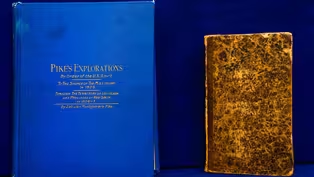
Appraisal: 1810 & 1889 Pike's Explorations Books
Video has Closed Captions
Clip: S29 Ep10 | 3m 16s | Appraisal: 1810 & 1889 Pike's Explorations Books (3m 16s)
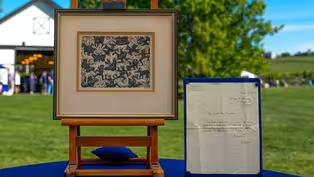
Appraisal: 1951 M.C. Escher "Plane Filling I" with Letter
Video has Closed Captions
Clip: S29 Ep10 | 3m 54s | Appraisal: 1951 M.C. Escher "Plane Filling I" with Letter (3m 54s)
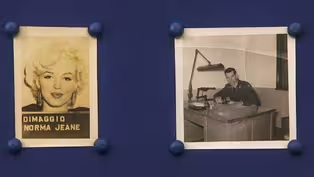
Appraisal: 1954 Marilyn Monroe Military Defense ID Photo
Video has Closed Captions
Clip: S29 Ep10 | 3m 9s | Appraisal: 1954 Marilyn Monroe Military Defense ID Photo (3m 9s)
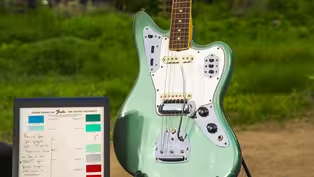
Appraisal: 1966 Fender Jaguar Custom Color Guitar & Chart
Video has Closed Captions
Clip: S29 Ep10 | 2m 2s | Appraisal: 1966 Fender Jaguar Custom Color Guitar & Chart (2m 2s)
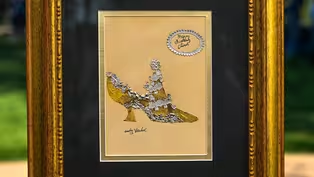
Appraisal: Andy Warhol Golden Shoe Collage, ca. 1956
Video has Closed Captions
Clip: S29 Ep10 | 4m 30s | Appraisal: Andy Warhol Golden Shoe Collage, ca. 1956 (4m 30s)
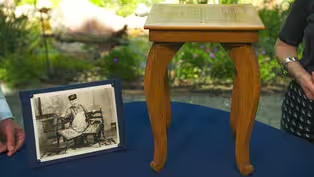
Appraisal: Anthyme Leveque Marquetry Taboret, ca. 1925
Video has Closed Captions
Clip: S29 Ep10 | 2m 37s | Appraisal: Anthyme Leveque Marquetry Taboret, ca. 1925 (2m 37s)
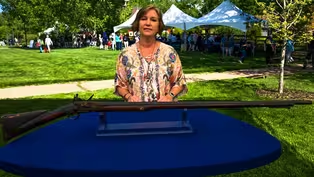
Appraisal: British-made Richard Wilson Musket, ca. 1755
Video has Closed Captions
Clip: S29 Ep10 | 3m 22s | Appraisal: British-made Richard Wilson Musket, ca. 1755 (3m 22s)
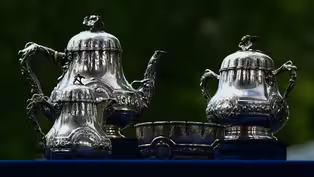
Appraisal: Cann & Dunn Coin Silver Tea Service, ca. 1856
Video has Closed Captions
Clip: S29 Ep10 | 1m 59s | Appraisal: Cann & Dunn Coin Silver Tea Service, ca. 1856 (1m 59s)
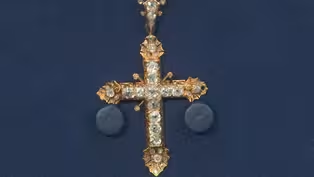
Appraisal: Diamond & Gold Cross Pendant, ca. 1890
Video has Closed Captions
Clip: S29 Ep10 | 2m 12s | Appraisal: Diamond & Gold Cross Pendant, ca. 1890 (2m 12s)
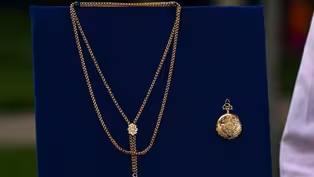
Appraisal: Elgin Pocket Watch & Double Chain, ca. 1923
Video has Closed Captions
Clip: S29 Ep10 | 2m 35s | Appraisal: Elgin Pocket Watch & Double Chain, ca. 1923 (2m 35s)
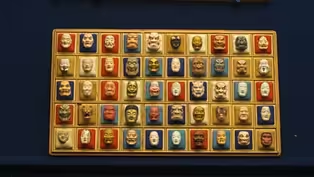
Appraisal: Japanese Noh Drama Mask Models, ca. 1920
Video has Closed Captions
Clip: S29 Ep10 | 2m 37s | Appraisal: Japanese Noh drama mask models, ca. 1920 (2m 37s)
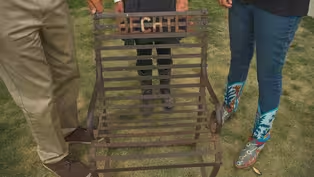
Appraisal: J. Bechtle Metal Chair, ca. 1865
Video has Closed Captions
Clip: S29 Ep10 | 1m 3s | Appraisal: J. Bechtle Metal Chair, ca. 1865 (1m 3s)
Appraisal: Joseph Yoakum Drawing, ca. 1965
Video has Closed Captions
Clip: S29 Ep10 | 2m 55s | Appraisal: Joseph Yoakum Drawing, ca. 1965 (2m 55s)
Appraisal: Pacific Coast Buckleback Jeans, ca. 1900
Video has Closed Captions
Clip: S29 Ep10 | 3m 6s | Appraisal: Pacific Coast Buckleback Jeans, ca. 1900 (3m 6s)
Appraisal: Raymor Glass Still Life Plaque, ca. 1955
Video has Closed Captions
Clip: S29 Ep10 | 2m 31s | Appraisal: Raymor Glass Still Life Plaque, ca. 1955 (2m 31s)
Preview: Denver Botanic Chatfield Farms, Hour 1
Video has Closed Captions
Preview: S29 Ep10 | 30s | Preview: Denver Botanic Chatfield Farms, Hour 1 (30s)
Providing Support for PBS.org
Learn Moreabout PBS online sponsorship
- Home and How To

Hit the road in a classic car for a tour through Great Britain with two antiques experts.

 New Episode











Support for PBS provided by:
Funding for ANTIQUES ROADSHOW is provided by Ancestry and American Cruise Lines. Additional funding is provided by public television viewers.